
Upgrading to a Variable-Speed Blower vs. Single-Stage for Better Fall Humidity Control
If your house feels cold but clammy during mild autumn weather, your AC might be short-cycling. See why upgrading your blower motor solves this sticky problem.

The 'Cold but Clammy' Dilemma During Early Fall
Why does the thermostat say 70 degrees, but you still feel the urge to turn down the air conditioner? If you are struggling with a house that feels cold but sticky, you are not alone. At Gibson Home Services LLC, our team frequently hears this complaint during the early autumn months. Upgrading to a variable-speed blower vs. single-stage for better fall humidity control is one of the most effective ways we recommend to solve this exact problem. As the intense heat of summer fades, traditional air conditioning systems often lose their ability to keep indoor air dry. The result is a damp, uncomfortable environment that leaves you shivering yet sweating.
Most homeowners do not realize that the temperature reading on the wall is only half of the comfort equation. Have you ever walked into your living room during the transition from summer to autumn and felt a distinct chill, yet your skin still feels sticky? This "cold but clammy" sensation is a widespread issue in homes that rely on standard cooling equipment during mild September weather. The thermostat might read a perfectly reasonable 72 degrees, but the environment inside feels heavy and uncomfortable.
Why Temperature Isn't the Whole Story
To understand why this happens, we have to look at how human beings perceive comfort. Our bodies cool themselves by evaporating sweat from our skin. When the air inside your home is loaded with moisture, that evaporation process slows down dramatically. You feel warmer and stickier than the actual air temperature suggests.
During the peak of summer, your air conditioner runs long enough to naturally strip this moisture out of the air. However, as the seasons change, the cooling load on your house drops. This creates a challenging scenario: evaluating whether an equipment upgrade is the right solution for persistent clamminess, or if your current system simply needs an adjustment. The reality our technicians see every day is that standard equipment is fundamentally limited in how it handles these transitional periods, leaving you trapped in a cycle of adjusting the thermostat without ever achieving true comfort.
How Single-Stage Systems Create the 'Short-Cycling' Trap
To grasp why your home feels so damp in the autumn, it helps to understand the mechanical limitations of traditional heating and cooling equipment. A standard air conditioner uses a single-stage blower motor. This means the system has exactly two settings: 100% on, or completely off. There is no middle ground, no low gear, and no ability to adapt to changing conditions.
When the system kicks on, it blasts cold air into the house at maximum capacity until the thermostat registers the target temperature. Once that number is hit, the system shuts down entirely. If you are scheduling routine AC service, our technicians will verify that the system is cooling properly, but we cannot change the fundamental physics of a single-stage motor.
The 15-Minute Cooling Blast
This all-or-nothing operation creates a phenomenon known as "short-cycling" during the autumn months. In our years of servicing the Delran NJ area, we have seen firsthand how our regional climate features coastal humidity that persists even when the actual temperature drops to comfortable levels in the 70s. Because the outdoor temperature is relatively mild, your powerful single-stage air conditioner can cool the house down to 70 degrees in just 10 to 15 minutes.
The underlying problem: Fifteen minutes is simply not enough time for the indoor evaporator coil to extract meaningful amounts of moisture from the air. Dehumidification is a slow, steady process. Air must pass continuously over the cold coils so that water vapor can condense and drain away. When your system short-cycles, it acts like a sprinter rather than a marathon runner. It drops the temperature quickly, shuts off abruptly, and leaves all the latent moisture hanging in the air. This on/off blast leaves the home cold, but filled with lingering moisture that makes everything feel clammy.
The Mechanics of Dehumidification: Enter the Variable-Speed Blower
The short answer to the short-cycling problem is changing how the air moves through your home. Dehumidification requires air to pass slowly and continuously over cold evaporator coils. If a single-stage motor is a light switch, a variable-speed blower (often called an ECM, or Electronically Commutated Motor) is a dimmer switch. It adapts its capacity based on the exact needs of the home at any given moment.
Just last fall, our installation team at Gibson Home Services worked with a local homeowner who needed a new HVAC system to resolve persistent indoor comfort issues. By focusing on the specific system needed to manage airflow—rather than just pushing a standard replacement box—we provided an installation with the precise capacity required to handle the home's unique seasonal loads without overcooling the space.
How Slower Speeds Extract More Moisture
Variable-speed technology fundamentally changes the way your home handles mild September weather. Instead of blasting air at 100% capacity, these sophisticated motors can ramp down, often running at just 30% to 60% of their maximum speed. This creates a completely different indoor environment.
1. Extended run times: Because the system is blowing cool air at a lower volume, it takes longer to reach the thermostat's set point. A cycle might last 45 minutes instead of 15.
2. Continuous condensation: During those 45 minutes, indoor air is constantly moving over the cold evaporator coil. This gives the system ample time to wring water vapor out of the air.
3. Temperature stability: The slow, steady flow of air removes humidity without drastically lowering the room temperature, preventing the "meat locker" effect.
4. Enhanced comfort: By stripping out the moisture, the air feels crisp and dry. You can often set your thermostat a few degrees higher and feel just as comfortable, if not more so.
This mechanical advantage is why we consider variable-speed equipment a cornerstone of modern indoor air quality services. It connects directly to the feeling of dry, comfortable air rather than cold, clammy air, completely eliminating the stagnant periods between cooling cycles.
Head-to-Head Comparison: Single-Stage vs. Variable-Speed Blowers
When we walk homeowners through an equipment upgrade, looking at the direct differences between the two technologies helps clarify why one performs so much better in the fall. The gap in performance becomes incredibly obvious when you look at how each system handles the specific demands of the Delran NJ area during transitional weather.
Understanding the Operational Differences
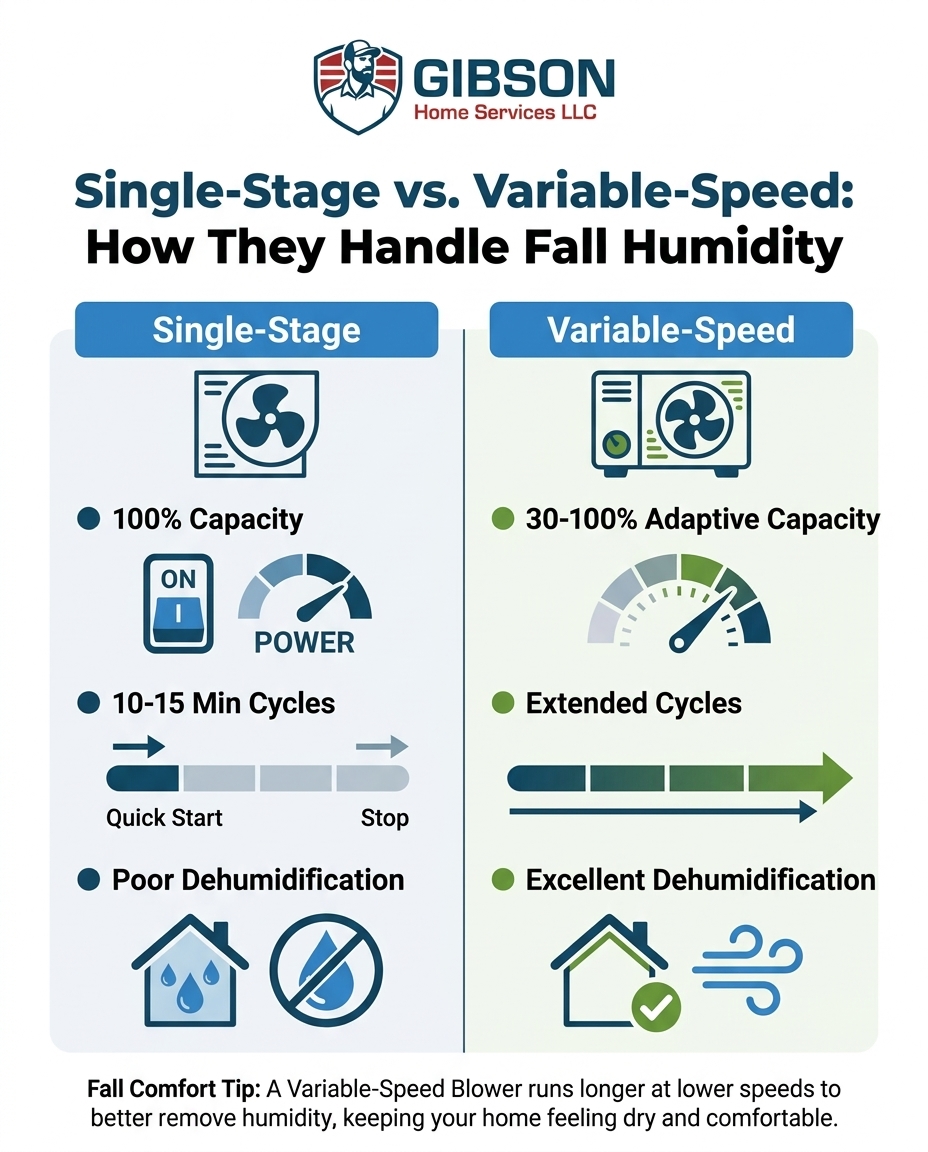
The table below breaks down exactly how these two blower types compare across the metrics that matter most for your daily comfort.
• Cooling Capacity — Single-Stage Blower: Fixed at 100% output whenever running. — Variable-Speed Blower: Adaptive; smoothly scales between 30% and 100%.
• Typical Run Times (Fall) — Single-Stage Blower: Short, rapid cycles lasting 10 to 15 minutes. — Variable-Speed Blower: Extended, continuous cycles lasting 30 to 60+ minutes.
• Mild-Weather Dehumidification — Single-Stage Blower: Poor; shuts off before moisture can be extracted. — Variable-Speed Blower: Excellent; long cycles wring out significant moisture.
• Electrical Consumption — Single-Stage Blower: Frequent, high-draw power surges upon start-up. — Variable-Speed Blower: Steady, low-draw operation that sips electricity.
• Temperature Consistency — Single-Stage Blower: Noticeable swings between hot and cold. — Variable-Speed Blower: Precise, steady temperatures within half a degree.
As the comparison shows, a single-stage system is simply the wrong tool for the job when the primary goal is removing humidity rather than dropping the temperature. The adaptive nature of the variable-speed motor aligns perfectly with the unpredictable nature of autumn weather, providing just enough cooling to keep the air moving and the moisture draining.
Beyond Humidity: Additional Advantages of Upgrading
While solving the clammy house problem is often the primary motivation for an upgrade, our customers find that variable-speed technology brings several secondary benefits that improve their overall quality of life. The same mechanical features that make these motors excellent at dehumidification also make them superior in almost every other aspect of HVAC performance.
During a major project last fall, our crew helped a local homeowner replace their furnace, air conditioner, and hot water heater all at once, and we found that upgrading to high-efficiency, variable-speed equipment was the clear choice. The new system not only resolved their immediate heating and cooling failures but also qualified for generic utility rebates, making the high-efficiency upgrade a highly practical long-term investment.
Quiet Operation and Better Filtration
Here are the additional advantages you can expect when moving away from single-stage equipment:
• Energy Efficiency: Because variable-speed motors often run at lower speeds, they consume significantly less electricity than a motor constantly starting and stopping at full power. This high-efficiency operation may qualify for generic energy rebates or tax credits, depending on current local and federal incentive programs.
• Noise Reduction: Single-stage motors are notorious for the loud "kick-on" noise that echoes through the vents. Variable-speed motors ramp up slowly and run whisper-quiet in the background, often so silently that you won't even realize the system is running.
• Superior Air Filtration: Your HVAC filter only cleans the air when the blower is moving air through it. Because variable-speed systems run for longer, continuous cycles, they pull significantly more air through the system's filter over the course of a day, dramatically improving overall indoor air quality.
• Even Temperatures: By keeping air constantly moving between floors and rooms, these systems eliminate the hot and cold spots that plague many homes during mild September weather.
Is a Variable-Speed Upgrade the Right Solution for Your Home?
Deciding to upgrade your heating and cooling equipment is a significant choice. While the comfort benefits of variable-speed technology are undeniable, it is important to evaluate your specific situation to determine if a replacement makes sense right now.
Our team at Gibson Heating & Cooling provides tailored system assessments that go beyond standard measurements. By taking the time to match the specific blower technology to your home's unique seasonal humidity profile, we ensure you get a customized solution rather than just a generic box off a truck.
Your Fall Comfort Checklist
If you are on the fence about upgrading, walk through this assessment checklist to see if your home in the Delran NJ area is a prime candidate for variable-speed technology:
• Assess the age of your current system: If your air conditioner or furnace is over 10 to 15 years old, investing in repairs is often a losing battle. A full replacement with variable-speed technology makes sense as a long-term investment.
• Consider your home's layout: Multi-story homes are notorious for trapping humidity upstairs while the downstairs freezes. If you have a two-story home, you will benefit immensely from the continuous air circulation that a variable-speed blower provides.
• Evaluate your current comfort levels: Pay attention to your thermostat behavior. If the screen says 72 degrees but you still feel the need to lower it to 68 just to remove the sticky feeling from the air, an upgrade is strongly warranted.
• Prioritize professional load calculations: Never guess at equipment sizing. We emphasize the importance of professional load calculations to match the right equipment capacity to your home's exact footprint. A comprehensive guide to AC installation always starts with proper sizing.
Frequently Asked Questions
Does a variable speed AC dehumidify better?
Yes, a variable-speed AC dehumidifies significantly better than standard models. Because the blower motor can run at lower speeds for extended periods, it allows indoor air to pass continuously over the cold evaporator coils. This extended contact time wrings much more moisture out of the air compared to a system that blasts cold air and shuts off quickly.
Why is my house cold but still humid in the fall?
Your house feels cold but humid because your standard air conditioner is short-cycling. During mild autumn weather, the system cools the house down to the target temperature very quickly—often in just 10 or 15 minutes. It shuts off before it has had enough time to extract the lingering latent moisture from the indoor air.
Is a variable speed blower worth the upgrade?
For most homeowners struggling with uneven temperatures or high indoor humidity, a variable-speed blower is absolutely worth the upgrade. Beyond solving clammy air issues, these systems operate much more quietly, use less electricity over time, and provide superior air filtration by keeping air constantly circulating through the home's filters.
What are the disadvantages of a variable speed AC?
The primary disadvantage of a variable-speed AC is the initial upfront installation cost, which is higher than a basic single-stage system. Additionally, the advanced electronic components in the ECM motor can be more complex to diagnose and repair if a failure occurs outside of the warranty period.
Can I add a variable-speed blower to my existing single-stage AC?
In our professional experience, you generally cannot simply swap a variable-speed blower into an older single-stage system. The indoor air handler and the outdoor condenser must be designed to communicate and work together. To get the true benefits of variable-speed technology, you typically need to replace the matched system components.
Take Control of Your Home's Comfort Before Winter
Living with a home that feels cold, damp, and clammy is a frustrating way to spend the autumn season. By upgrading to a variable-speed system, you gain precise control over both temperature and humidity, ensuring your indoor environment stays perfectly balanced. If you are tired of fighting your thermostat, exploring an air conditioning replacement in Delran with our team can provide the reliable, dry comfort your family deserves.
Latest articles
Discover more articles

Upgrading to a Variable-Speed Blower vs. Single-Stage for Better Fall Humidity Control
If your house feels cold but clammy during mild autumn weather, your AC might be short-cycling. See why upgrading your blower motor solves this sticky problem.
Can I Get a 24/7 Heat Pump Repair on a Weekend in Marlton?
When your system fails on a Friday night, you need to know if an emergency call means a real fix or just a patch. Find out what a weekend service call actually covers.
The Truth About Dead Compressors and Aggressive Replacement Quotes
A sudden AC breakdown is stressful when a technician immediately condemns your entire system. Before signing a replacement contract, see why a 'dead' compressor might just be a minor electrical issue.