
Repairing a 12-Year-Old Furnace vs. Upgrading to a 96% AFUE Model
A failing draft inducer right before winter forces a tough choice. Weigh the immediate repair of your aging system against the long-term reliability of a high-efficiency replacement.

Facing a Furnace Breakdown Just as Winter Arrives?
Is there anything more stressful than weighing the choice between repairing a 12-year-old furnace vs. upgrading to a 96% AFUE model when your heating system starts making strange noises just as November pre-winter temperatures drop? You rely on your heating system to keep your home safe and comfortable, and when it fails to ignite or begins grinding right before the cold sets in, the pressure to make a fast decision is immense. The house gets cold quickly, and you are suddenly faced with a complex dilemma: do you spend money fixing a specific failing component on an older unit, or do you invest in a high-efficiency replacement?
When you need reliable heating services, having an objective framework helps you evaluate both paths clearly. At Gibson Home Services, our team has spent years guiding Delran homeowners through these exact scenarios. This guide provides our straightforward, pressure-free look at the realities of aging heating equipment so you can make the best choice for your home.
Understanding the Draft Inducer's Role in a 12-Year-Old Furnace
To make an informed decision, you first need to understand the mechanical failure at hand. One of the most common components our technicians see fail on an aging system is the draft inducer motor. This part plays a critical safety role: it clears lingering combustion gases out of the heat exchanger before the burners ignite. Because it is a non-negotiable safety component, if the draft inducer fails or struggles to reach the proper speed, the furnace's internal safety switches will prevent the system from running at all.
When this component begins failing on a 12-year-old furnace, it is rarely an isolated incident. A pattern we see often is that it's a symptom of compounding wear and tear across the entire system. One winter, a local homeowner experienced an urgent heater breakdown right after moving into their new home. Our team at Gibson Home Services prioritized the call, thoroughly checked the heater's components, and kept the customer constantly updated on the exact parts needed before successfully repairing the unit. This kind of diligent, honest diagnostic process is crucial to determine if a failing inducer is just a minor hiccup or the first of many end-of-life failures. Consistent heating maintenance can sometimes catch these issues early, but eventually, mechanical parts simply reach the end of their lifespan.
Why This Component Fails Over Time
Continuous exposure: The draft inducer lives in a harsh environment. Over 12 or more heating seasons, continuous exposure to extreme heat, moisture from exhaust gases, and constant vibration naturally degrades the motor bearings.
Lack of consistent care: While professional tune-ups can extend the life of these motors by ensuring proper airflow and reducing strain, skipping preventative care often accelerates this wear, leading to premature failure.
The Ripple Effect on Your Heating System
Electrical strain: A struggling inducer motor does not just fail quietly. As the bearings wear out, the motor draws excessive electrical current to keep spinning, which puts unnecessary strain on the furnace's main control board.
System lockout: Ignoring early warning signs—like a loud humming or grinding noise coming from the furnace before the blower kicks on—can lead to a sudden, total system lockout, leaving you without heat on the coldest night of the year.
The Short-Term Fix: Replacing the Draft Inducer on an Aging System
Replacing the inducer motor is often the fastest way to restore heat immediately, which is highly appealing when your house is freezing. However, it is essential to objectively analyze the pros and cons of repairing the existing 12-year-old unit before committing your resources.
Our HVAC professionals at Gibson Home Services often refer to the "50% rule" for furnace repairs: you should weigh the proportion of the repair against the remaining value of the aging unit. Because 12-year-old furnaces are typically well out of their original 10-year parts warranties, any repair you authorize is entirely out-of-pocket. When sourcing parts for these older systems, understanding the difference between OEM vs. universal furnace parts can impact how long the repair actually lasts.
When Repair Makes the Most Sense
• Pristine maintenance history: If the rest of the system has been meticulously maintained, the heat exchanger is in perfect condition, and there are no signs of secondary wear on the blower motor.
• Short-term necessity: If a full replacement is simply not feasible in the immediate short term, a repair acts as a necessary bridge to keep your home safe and warm.
The Hidden Risks of Sunk Costs
• The band-aid approach: Fixing the inducer does not reset the clock on the rest of the furnace. You risk pouring resources into a system where the blower motor or gas valve might fail next month.
• Stagnant efficiency: By keeping the old unit alive, you continue to operate at the lower efficiency levels typical of older standard models, meaning your utility usage remains high.
The Long-Term Solution: Upgrading to a 96% AFUE High-Efficiency Furnace
If you decide against the short-term fix, we recommend upgrading to a modern, high-efficiency system as the alternative. But what does 96% AFUE actually mean for your home? AFUE stands for Annual Fuel Utilization Efficiency. In practical terms, a 96% AFUE furnace converts 96 percent of the fuel it consumes directly into usable heat for your home, with only 4 percent lost as exhaust waste.
Contrast this with a standard 12-year-old unit, which likely operates at around 80% AFUE (or lower, due to age-related degradation). Upgrading represents a massive, proportional reduction in energy waste. A thorough evaluation is always the first step. In one recent pre-winter scenario, our team evaluated a system where the homeowner initially believed expensive, multiple-part repairs were needed. However, upon further inspection, our Gibson Home Services technician found that replacing those parts wasn't actually necessary, resolving the issue with less work and saving the customer significant resources. But when an aging system truly is beyond reasonable repair, upgrading provides undeniable long-term benefits, including the deep peace of mind that comes with a new 10-year parts warranty.
Understanding the Utility Impact
Less fuel required: Because the system wastes so little energy, it requires significantly less fuel to achieve the exact same indoor temperature as your old unit.
Compounding efficiency gains: Over the 15 to 20-year lifespan of a new 96% AFUE unit, that reduction in fuel consumption compounds, making the system vastly more efficient to operate season after season.
Modern Safety and Diagnostic Features
Advanced control boards: Newer systems feature smart control boards that provide highly specific diagnostic codes, making future maintenance faster and more precise.
Sealed combustion: High-efficiency models utilize sealed combustion designs that draw air directly from outside rather than pulling conditioned air from inside your home. This improves overall indoor air quality and enhances operational safety.
Weighing Efficiency Gains and Warranty Protection Against Immediate Costs
When evaluating your options, our team always suggests looking at the proportional value rather than just the immediate fix. An aging 80% AFUE system requires more energy to heat your home and carries the constant, looming threat of out-of-pocket breakdowns. A new 96% AFUE system minimizes energy waste and shifts the burden of part failures back onto the manufacturer via warranty.
To help offset the initial investment of an upgrade, there are often generic federal tax credits and local utility rebates available for qualifying high-efficiency installations. Furthermore, modern HVAC financing options can make a full replacement highly manageable, allowing you to upgrade your comfort without draining your savings to cover a sudden, large out-of-pocket repair bill.
Navigating Rebates and Incentives
Many high-efficiency upgrades qualify for energy-efficiency incentives designed to encourage greener home heating. Because these programs change frequently, it is always advisable to verify current generic programs with a tax professional or your local utility provider to maximize the value of your installation.
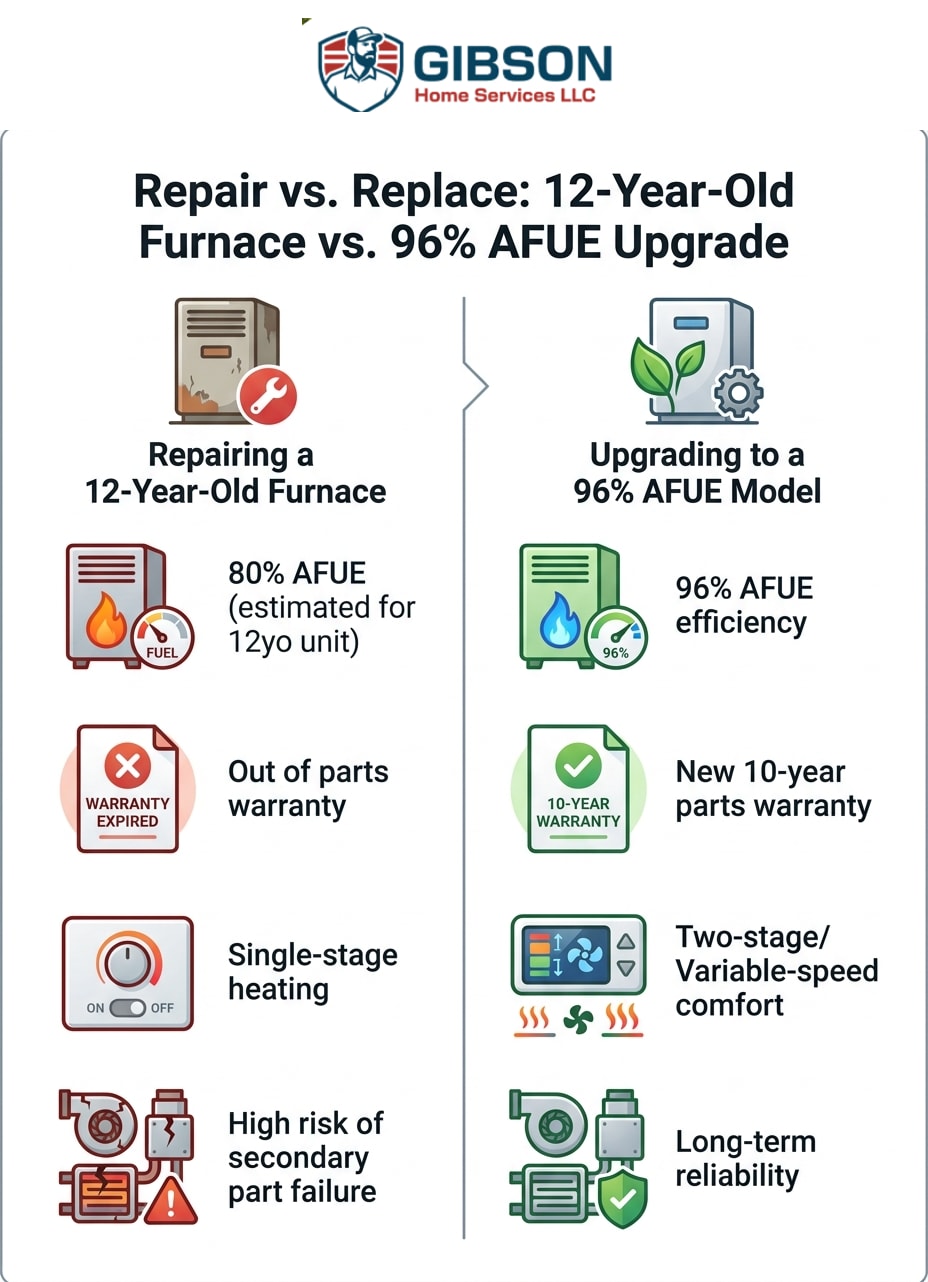
• Energy Waste — 12-Year-Old Furnace (80% AFUE): Wastes 20% or more of consumed fuel — New High-Efficiency Upgrade (96% AFUE): Wastes only 4% of consumed fuel
• Warranty Status — 12-Year-Old Furnace (80% AFUE): Out of original 10-year parts warranty — New High-Efficiency Upgrade (96% AFUE): Protected by new 10-year parts warranty
• Comfort Technology — 12-Year-Old Furnace (80% AFUE): Standard single-stage heating — New High-Efficiency Upgrade (96% AFUE): Two-stage or variable-speed blower options
• Breakdown Risk — 12-Year-Old Furnace (80% AFUE): High risk of secondary component failure — New High-Efficiency Upgrade (96% AFUE): Highly reliable with modern safety controls
Why November Timing Changes the Repair vs. Replace Math
The decision between repairing and replacing does not happen in a vacuum—it happens in a specific climate at a specific time of year. In Delran, NJ, November marks the definitive start of the heating season. As average low temperatures drop into the freezing 30s, heating shifts from being an occasional comfort to a continuous, critical necessity.
The Problem: If you choose a band-aid repair on a 12-year-old furnace in November, you carry the compounding risk of a mid-winter breakdown. If the repaired older unit fails again during a January deep freeze, your home's temperature will plummet rapidly, putting your property at severe risk of freezing pipes.
The Cause: Older systems are simply less resilient to the continuous, heavy usage required to combat prolonged freezing temperatures typical of Delran winters. When pushed to their limits, weakened secondary components fail.
The Solution: Securing a reliable, high-efficiency system in late fall guarantees uninterrupted warmth during the harshest months. One November, a local homeowner realized their old furnace desperately needed updating for better value and reliability. Our Gibson Home Services installation team arrived exactly on time and completely replaced the furnace and AC unit with no hidden costs, clearly explaining how the new equipment functioned. Being proactive before the deep cold sets in avoids the stress of emergency, off-hours breakdowns when you need heat the most.
An Honest Framework for Your Heating Decision
Ultimately, there is no one-size-fits-all answer to the repair versus replace dilemma. The right choice depends entirely on the specific condition of your home's heating system and your long-term utility goals. Gibson Home Services provides transparent, honest evaluations to help you weigh these factors without any high-pressure sales tactics. We believe in giving you the facts based on our years of field experience so you can make the best choice for your family.
Before committing to a path, review this mental checklist:
• Age of the unit: Is the furnace over 10-12 years old and nearing the end of its statistical lifespan?
• Warranty status: Are you fully responsible for the out-of-pocket costs of this repair and any future failures?
• Repair proportion: Does the cost of fixing the draft inducer exceed 50% of what the aging unit is currently worth?
• Utility goals: Are you tired of high winter energy bills and ready to benefit from a 96% AFUE system?
Frequently Asked Questions About Furnace Upgrades and Repairs
Is a draft inducer worth replacing on an older furnace?
It depends heavily on the overall condition of the system. If the furnace is well-maintained and under 10 years old, replacing the inducer is usually a smart move. However, on a 12-year-old unit that is out of warranty, our team typically finds that an inducer failure is a warning sign of compounding wear, making a replacement less financially viable.
How much more efficient is a 96% AFUE furnace compared to a 12-year-old model?
A 96% AFUE furnace is vastly more efficient, converting 96 percent of its fuel into usable heat. A typical 12-year-old furnace generally operates around 80% AFUE (or lower due to wear), meaning a new high-efficiency model reduces energy waste by a significant proportional margin, directly lowering utility consumption.
What are the signs my furnace needs replacing before winter?
Key warning signs include frequent breakdowns, loud grinding or humming noises, a yellow burner flame instead of blue, and an inability to maintain the temperature set on the thermostat. If your system is over a decade old and exhibiting these symptoms in November, we strongly suggest a proactive replacement.
What exactly happens when a furnace draft inducer fails?
When the draft inducer fails, it cannot effectively clear combustion gases from the heat exchanger. Because this is a critical safety function, the furnace's pressure switch will detect the lack of airflow and automatically lock out the ignition sequence, preventing the furnace from running entirely.
How long do high-efficiency 96% AFUE furnaces typically last?
With proper, consistent professional maintenance, a high-efficiency 96% AFUE furnace can reliably last 15 to 20 years. Their longevity is supported by modern, durable components and advanced safety controls that protect the system from catastrophic strain.
Can I upgrade to a 96% AFUE furnace if I currently have an 80% model?
Yes, you can absolutely upgrade from an 80% model to a 96% AFUE furnace. The upgrade process typically requires modifying the venting system, as high-efficiency furnaces use PVC piping to vent exhaust and draw in fresh combustion air, but a qualified professional can easily manage this transition.
Secure Your Home's Comfort Before the Deep Cold Sets In
Making a confident, informed choice between repairing an aging system and upgrading to a high-efficiency model is the best way to protect your home. Resolving a failing draft inducer on a 12-year-old furnace now—during the November pre-winter window—prevents catastrophic emergency disruptions during the peak of the Delran deep freeze. Do not wait for a total system lockout to force your hand; schedule a professional evaluation with Gibson Home Services today to determine the exact state of your heating system and secure your family's comfort for the season ahead.
Latest articles
Discover more articles

Dealing with Drafty Sunrooms in Cherry Hill During November
As pre-winter temperatures drop, heating a glass-heavy three-season room is a challenge. Find out if extending central ductwork or adding a mini-split is the smartest permanent fix.
Repairing a 12-Year-Old Furnace vs. Upgrading to a 96% AFUE Model
A failing draft inducer right before winter forces a tough choice. Weigh the immediate repair of your aging system against the long-term reliability of a high-efficiency replacement.
Is a 24-Hour Emergency Furnace Repair in Moorestown Worth the Extra Cost?
When your heating fails at 3 AM during a November cold snap, panic sets in. Use this clear framework to decide if you need an immediate after-hours dispatch.