
Calibrating Your Thermostat Before the First Deep Freeze of November
A drifting thermostat sensor can leave your home shivering while the screen claims it's perfectly warm. Use this simple glass thermometer test to verify your system's accuracy before winter hits.

The Threat of a Drifting Sensor During a Late-Autumn Temperature Drop
Before the first major frost hits the mid-Atlantic, there is one critical component of your heating system that requires immediate attention. Calibrating your thermostat before the first deep freeze of November is the most reliable way to ensure your furnace actually delivers the warmth you expect. At Gibson Home Services LLC, our technicians frequently see thermostats experience sensor drift during the off-season, a subtle loss of accuracy that causes the device to misread the ambient temperature in your home. When a sudden November cold snap arrives, a drifting sensor can cause your heating system to severely under-heat your living spaces, leaving you shivering while the digital display falsely claims the room is perfectly comfortable.
To protect your home from unexpected seasonal discomfort, professional verification is the ultimate safeguard. If you need assistance correcting a stubborn temperature discrepancy, scheduling thermostat services alongside your annual heating maintenance will ensure your equipment responds accurately to every drop in weather.
Understanding how your thermostat communicates with your furnace is the first step in diagnosing a heating shortfall. The internal sensor acts as the brain of your entire HVAC system. If that brain is operating on flawed data, even the most powerful, high-efficiency furnace will fail to keep your family warm. A pattern we see often is a thermostat that reads just three degrees higher than the actual room temperature, shutting the heating cycle down prematurely. As the outdoor temperatures plummet, this short-cycling behavior prevents the heat from reaching the furthest bedrooms in your house, creating frustrating cold spots and forcing you to constantly manually adjust the settings.
Taking proactive steps now prevents emergency service calls later. By isolating the exact cause of the temperature gap, you can determine whether your system requires a simple recalibration or a more comprehensive repair before winter fully sets in.
Why Your Home Feels Colder Than the Thermostat Indicates
In our years of preparing local homes for the winter, our team often finds homeowners wearing heavy sweaters indoors while staring at a thermostat screen that proudly reads seventy-two degrees. This frustrating gap between your perceived comfort and the actual room temperature almost always traces back to a loss of factory calibration. During the long summer and mild early autumn months, your heating system sits idle. Over this extended off-season, microscopic layers of airborne dirt, pet dander, and household dust settle onto the sensitive thermistor or bimetallic coil inside the thermostat housing. This insulating layer of debris alters how the sensor reacts to the surrounding air, creating a delayed or distorted temperature reading.
Accidental bumps from moving furniture, aggressive dusting, or even natural vibrations from the wall can also knock an older mechanical thermostat out of its perfectly leveled position, throwing off its internal mercury switch or magnetic contacts. It is important to distinguish between a total mechanical failure and a simple calibration drift. A mechanical failure usually results in a blank digital screen, unresponsive buttons, or a furnace that refuses to turn on at all. A calibration drift, however, means the system is still communicating, but it is operating on bad intelligence. This forces the heating system to waste energy by running at the wrong times or failing to reach comfortable ambient temperatures when you need it most.
In our region, the weather does not transition gently. The climate in Delran NJ is known for sharp late-autumn temperature drops, where a mild afternoon can quickly give way to a freezing night. These sudden shifts make a drifting thermostat sensor immediately noticeable and deeply uncomfortable. The house loses heat to the outdoors faster than the compromised thermostat realizes, leaving you waking up to a freezing home. Addressing this sensor accuracy is a vital part of transitioning your thermostat for the colder months. By clearing the dust and verifying the internal readings, you restore the precise control necessary to combat the unpredictable mid-Atlantic weather patterns.
Executing the Glass Thermometer Test Safely
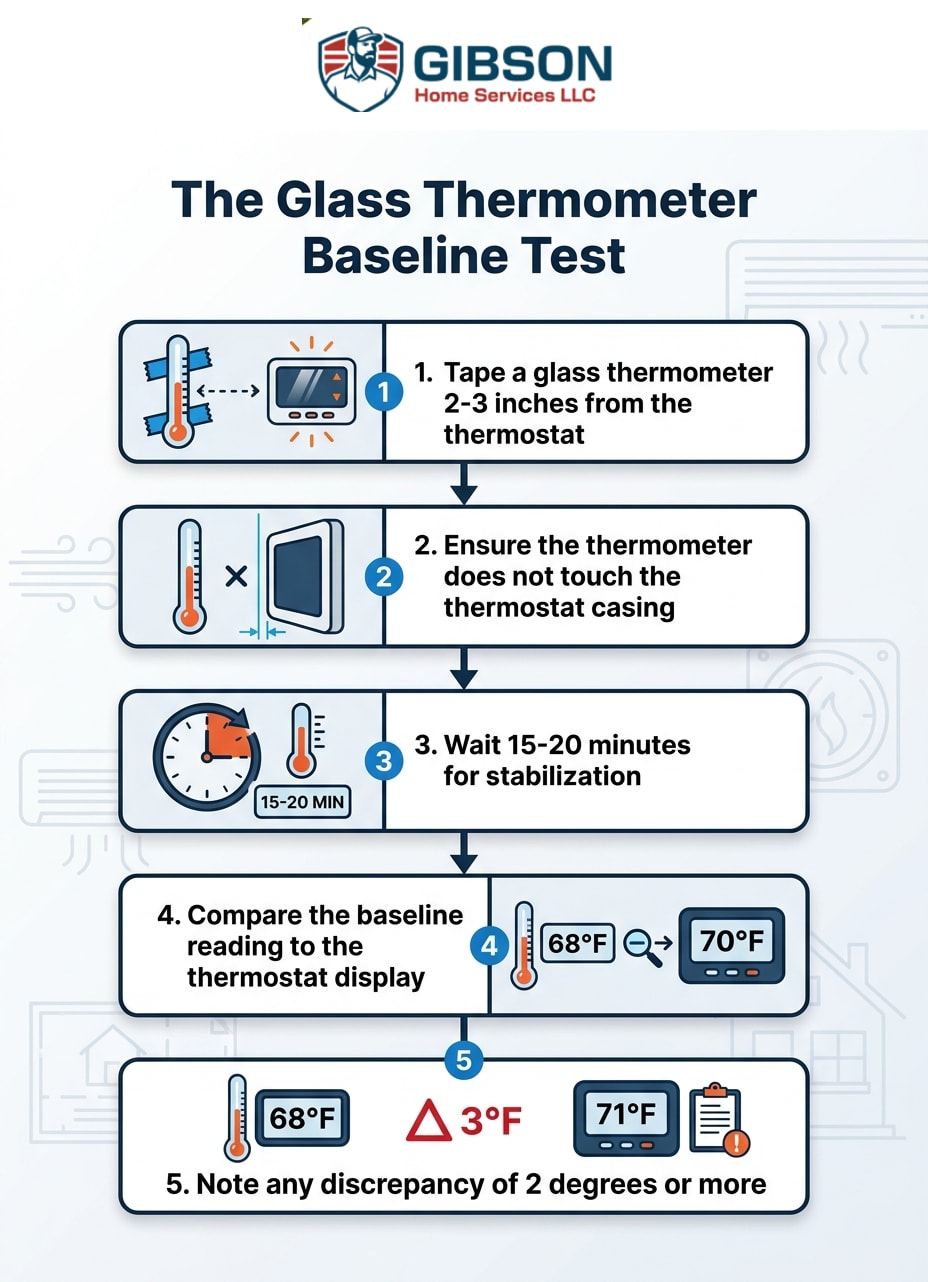
Before you assume your furnace is failing or your thermostat needs a total replacement, you should establish a reliable glass thermometer baseline. This safe, straightforward diagnostic method allows you to verify the accuracy of your wall unit without exposing any electrical components, touching any high-voltage wires, or opening the sensitive internal housing. By comparing your thermostat's digital display to an independent, analog reading, you can pinpoint exactly how far the internal sensor has drifted.
Follow these specific, numbered steps to perform the baseline test accurately in your own home:
1. Acquire a standard glass thermometer: Use a basic analog glass thermometer, as they are not subject to the same electronic sensor drift or low-battery glitches that affect digital devices.
2. Position the thermometer correctly: Using a piece of gentle painter's tape, secure the glass thermometer to the wall approximately two to three inches away from the thermostat.
3. Avoid physical contact: Ensure the glass thermometer is not touching the plastic casing of the thermostat itself. Digital thermostats generate a tiny amount of internal heat from their electronic displays, which can artificially inflate the reading if the two devices are touching.
4. Allow the environment to stabilize: Wait a full 15 to 20 minutes. This gives the liquid inside the glass thermometer ample time to adjust to the ambient air currents in the hallway or living room.
5. Record the glass thermometer baseline: Check the analog reading on the glass thermometer and immediately compare it against the digital or analog display on your thermostat. Write both numbers down.
Common Mistakes to Avoid During the Test: Do not perform this test immediately after cooking a large meal, running the dryer, or taking a hot shower, as temporary humidity and heat spikes will skew the ambient air temperature. Additionally, ensure no direct sunlight is hitting either the wall unit or the glass thermometer during your 20-minute waiting period.
Interpreting Your Temperature Discrepancy
Once you have established your glass thermometer baseline, you must interpret what the temperature offset actually means for your home heating strategy. Not every minor difference requires immediate intervention, but ignoring a significant gap will lead to diminished comfort and inflated utility bills. Understanding the acceptable margin of error helps you make an informed decision about your next steps.
According to U.S. Department of Energy guidelines—and a standard our team at Gibson Home Services LLC strongly stands by—a well-calibrated unit should read within one degree of the actual room temperature. If your baseline test reveals a discrepancy of a single degree, your system is operating within normal factory tolerances. However, if the offset grows to two, three, or even four degrees, you are dealing with a problematic drift that requires correction.
• 0 to 1 Degree — System Impact: Normal operation. Furnace cycles efficiently. — Recommended Action: No action required. Continue standard seasonal use.
• 2 to 3 Degrees — System Impact: Moderate drift. Frequent short-cycling or over-heating. — Recommended Action: Check for dust buildup; schedule a professional recalibration.
• 4+ Degrees — System Impact: Severe drift. Significant energy waste and comfort loss. — Recommended Action: Immediate professional diagnostic; possible thermostat replacement.
A significant discrepancy forces your furnace into highly inefficient operating patterns. If the thermostat reads lower than the actual room temperature, the furnace will run in excessively long cycles, overheating the house and driving up your monthly utility costs. Conversely, if the thermostat reads higher than the actual temperature, the heating system will shut off too early, leaving you freezing. Knowing the true temperature offset gives you the clear criteria needed to act. If the gap is three degrees or larger, simple DIY dusting is rarely enough to fix the problem, and a professional recalibration is the safest route forward.
How Calibration Impacts Different Heating Systems
The consequences of a poorly calibrated thermostat vary heavily depending on the specific type of heating equipment installed in your home. Different heating systems rely on accurate thermostat data in unique ways to manage their cycling processes. A forced-air furnace reacts differently to bad temperature data than a radiant heating setup. Recognizing how your specific system utilizes sensor data ensures the equipment operates at peak performance before winter arrives in Delran NJ.
Heat Pump Efficiency and Sensor Data
Heat pumps are incredibly efficient, but they require highly precise temperature data to operate correctly. A heat pump transfers heat from the outside air into your home, but during extreme cold, it relies on auxiliary electric heat strips to make up the difference. If your thermostat is out of calibration and falsely believes the indoor temperature is dropping rapidly, it will trigger these emergency heat strips unnecessarily. This completely defeats the energy-saving benefits of the heat pump and causes massive spikes in electrical usage. Proper calibration ensures steady, efficient cycling without relying on the expensive backup heat. If you suspect your system is engaging auxiliary heat too frequently, scheduling heat pump services can help realign the sensors and restore efficient operation.
Boiler Systems and Radiant Heat Control
Homes equipped with boiler systems face a different set of challenges when the thermostat drifts. Boilers distribute radiant heat through baseboards or under-floor piping. Radiant heat has a high thermal mass, meaning it takes longer to warm up the space, but the heat lingers long after the system shuts off. If a thermostat is poorly calibrated and reads the room as too cold, it will force the boiler to run entirely too long. By the time the faulty thermostat finally registers the correct temperature and shuts the boiler off, the radiant pipes are already fully loaded with boiling water. This causes the room to severely overshoot the target temperature, making the home uncomfortably hot and stuffy. Accurate ambient readings are absolutely essential to prevent radiant systems from over-heating the space, ensuring consistent, even comfort throughout the home.
When to Stop Testing and Call a Local Professional
While the glass thermometer test is a fantastic way to gather data, there is a strict boundary between safe DIY testing and the need for a licensed HVAC technician. Homeowners should never attempt to rewire, disassemble, or open the internal electrical housing of the thermostat themselves. Modern thermostats carry low-voltage wiring that connects directly to the sensitive control boards inside your furnace or boiler. A single misplaced wire or accidental short circuit can instantly destroy the main control board, turning a minor calibration issue into a massive system failure.
You should immediately stop testing and call a professional if you notice any of the following warning signs:
• A completely unresponsive furnace: If adjusting the thermostat makes no difference and the heating system refuses to engage, the issue has moved beyond a simple sensor drift.
• Rapid clicking noises: If the wall unit clicks repeatedly but the blower motor never turns on, the internal relay switch is likely failing.
• Blank digital displays: A screen that flickers or stays dark even after fresh batteries are installed indicates an electrical fault.
• Short-cycling behavior: If the heating system turns on and off every three minutes, the thermostat is sending erratic signals that could damage the blower motor.
Having a professional verify the entire heating system's performance before freezing weather sets in is invaluable. We recently had a Delran homeowner reach out during a sudden winter freeze when their heater broke unexpectedly shortly after moving into a new home. Our team made it a priority to visit, kept the customer updated during the part ordering process, and successfully resolved the heating issue from start to completion. Prompt professional attention prevents unexpected breakdowns during peak winter months. If you are dealing with an unresponsive radiant system, seeking boiler repair in Delran ensures your equipment is handled by technicians who understand the specific demands of the region. When you work with our team at Gibson Home Services LLC, you benefit from locally tailored HVAC expertise; we inherently understand how to prepare sensitive heating systems specifically for New Jersey's abrupt, demanding seasonal transitions, right down to the incoming November cold snap.
Frequently Asked Questions About Thermostat Accuracy
How do I know if my thermostat is reading the right temperature?
The most reliable way to know if your thermostat is reading the right temperature is to perform a glass thermometer baseline test. By taping a standard analog thermometer to the wall a few inches away from the unit and waiting twenty minutes, you can compare the two readings. If the numbers match within one degree, your thermostat is highly accurate. If there is a discrepancy of three degrees or more, the internal sensor is misreading the room.
Why does my house feel colder than the thermostat says?
Your house feels colder than the thermostat says because the internal temperature sensor has likely drifted out of factory calibration. Over the summer months, layers of dust and airborne debris can coat the sensor, acting as an insulator that prevents it from feeling the true chill in the air. This causes the digital display to show a falsely high number, prompting the furnace to shut off before the room is actually warm.
Can a digital thermostat lose its calibration?
Yes, a digital thermostat can absolutely lose its calibration over time. While modern digital units do not rely on the liquid mercury switches of older models, they use electronic thermistors that are highly sensitive to dirt, static electricity, and subtle voltage fluctuations. Even a slight accumulation of household dust inside the plastic casing can throw off the digital sensor's ability to accurately measure ambient heat.
How often should I test my thermostat's accuracy?
We recommend testing your thermostat's accuracy at least once a year, ideally in the late autumn before you turn on the primary heating system for the first time. Verifying the glass thermometer baseline during this transitional period gives you plenty of time to schedule a recalibration if needed. Regular annual testing prevents you from discovering a severe temperature offset during the middle of a winter freeze.
Does thermostat placement affect temperature readings?
Thermostat placement drastically affects temperature readings and overall system performance. If the unit is installed in direct sunlight, near a drafty window, or directly above a heating vent, it will constantly register false environmental data. The thermostat will think the house is much hotter or colder than it actually is, causing the furnace to cycle improperly and leaving the rest of the home uncomfortable.
Secure Your Winter Comfort Before the Freeze
Taking the time to establish a glass thermometer baseline provides immense peace of mind as the seasons change. Knowing the exact, true temperature offset of your wall unit allows you to stop guessing about your family's comfort and start taking targeted action. When you understand exactly how your thermostat is communicating with your furnace, you can make informed decisions about your home's energy efficiency.
If your baseline test reveals a frustrating discrepancy, do not wait for the inevitable November cold snap to push your system to the breaking point. Encourage reliable, efficient heating by scheduling professional heating maintenance today. A licensed technician from our team can safely recalibrate your sensors, clean the internal components, and ensure your entire HVAC system is fully prepared to handle whatever the winter weather brings.
Latest articles
Discover more articles

Dealing with Drafty Sunrooms in Cherry Hill During November
As pre-winter temperatures drop, heating a glass-heavy three-season room is a challenge. Find out if extending central ductwork or adding a mini-split is the smartest permanent fix.
Repairing a 12-Year-Old Furnace vs. Upgrading to a 96% AFUE Model
A failing draft inducer right before winter forces a tough choice. Weigh the immediate repair of your aging system against the long-term reliability of a high-efficiency replacement.
Is a 24-Hour Emergency Furnace Repair in Moorestown Worth the Extra Cost?
When your heating fails at 3 AM during a November cold snap, panic sets in. Use this clear framework to decide if you need an immediate after-hours dispatch.