
The Truth About Dead Compressors and Aggressive Replacement Quotes
A sudden AC breakdown is stressful when a technician immediately condemns your entire system. Before signing a replacement contract, see why a 'dead' compressor might just be a minor electrical issue.

Facing a Sudden Breakdown and a Massive Replacement Quote?
Your air conditioner suddenly shuts down on a warm afternoon, and before you know it, you are trying to uncover the truth about dead compressors and aggressive replacement quotes from a technician standing in your living room. A sudden cooling breakdown is always stressful, but that stress multiplies when a service technician immediately condemns your entire system. You are suddenly handed a clipboard with a massive contract and told that your system cannot be saved.
Homeowners are often pushed to sign replacement contracts on the spot out of pure panic. The house is getting warmer, your family is uncomfortable, and the technician insists that acting right now is your only option. This creates a critical decision point: deciding whether to sign a major contract immediately or pause to get a second opinion focused specifically on your system's electrical components.
If you need honest air conditioning services or reliable AC repair in Delran, NJ, our team is here to help you find the right solution without the high-pressure sales tactics.
The Psychology of the Emergency Service Call
When you lose cooling, you are in a vulnerable position. You just want your home to be comfortable again. Unfortunately, some aggressive sales technicians are trained to exploit this exact moment. They know that if they can convince you that your compressor has suffered a catastrophic failure, you are highly likely to agree to a full system replacement just to make the problem go away.
During the September early-fall transition, your cooling system has already endured months of heavy operation. Parts are tired, and minor electrical failures are incredibly common. However, instead of offering a simple fix for a fatigued part, some technicians use this seasonal timing to claim your system has simply reached the end of its lifespan. Understanding how these misdiagnoses happen is your best defense against unnecessary expenses.
The Anatomy of a Misdiagnosis: Capacitor vs. Compressor
To understand why so many air conditioners are falsely condemned, you have to look at the most common reason for a sudden breakdown: electrical control failure. In the vast majority of service calls, the root cause of a system failing to turn on is a relatively inexpensive electrical component, not a catastrophic mechanical failure.
What Does a Dual Run Capacitor Actually Do?
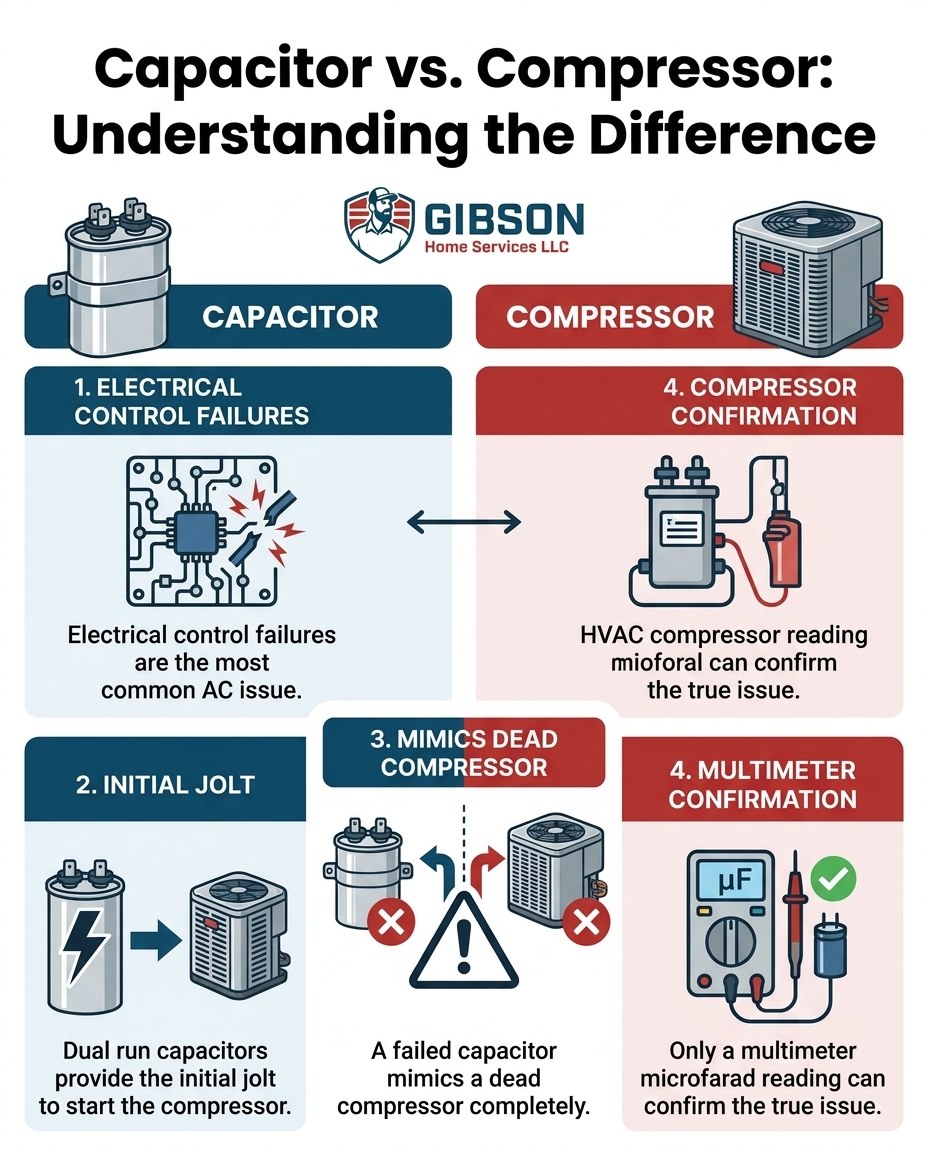
Your air conditioner's compressor requires a massive jolt of electricity to start up—much more power than your home's standard electrical wiring can provide all at once. This is where the dual run capacitor comes in. It acts similar to a large battery, storing up electrical energy and delivering a powerful boost to get the compressor motor spinning. Once the compressor is running, the capacitor continues to provide a steady, regulated stream of power to keep it operating smoothly.
Delran's hot, humid summer weather forces AC units into long, grueling cycles. By the time the early fall arrives, your dual run capacitor has charged and discharged thousands of times. This constant heavy workload causes severe electrical component fatigue. Eventually, the capacitor simply wears out and fails to deliver that necessary starting jolt.
Why the Symptoms Overlap So Perfectly
When a dual run capacitor blows, the compressor physically cannot start. You might hear the system hum loudly for a few seconds before clicking off. This happens because the compressor is trying to pull power, failing to start, overheating, and then shutting down on its internal thermal overload protector to prevent a fire. To the untrained ear, a humming, non-starting compressor sounds exactly like a seized, completely dead compressor.
A typical pattern we see during the summer involves a homeowner calling for help after another company quoted a massive compressor replacement. When a second technician arrives to take a look, they often find the true issue is minor. They fix the AC without replacing the compressor at all, getting the system up and running quickly—saving the homeowner a significant amount of money.
Aggressive sales technicians exploit this exact symptom overlap. They know the compressor isn't turning on, and they use that visual evidence to push a full system replacement rather than offering the simple electrical fix. The only way to know the difference is by taking a proper multimeter microfarad reading on a dual run capacitor to see if it is still holding a charge.
Red Flags Your 'Dead' Compressor Diagnosis Might Be Wrong
You do not need to be an HVAC expert to spot a questionable diagnostic approach. Aggressive sales tactics usually follow a very predictable pattern. If you know what to look for, you can protect yourself from signing a contract you do not actually need. Here are the clear warning signs that your technician might be pushing a false narrative.
• Visual and sound-based diagnostics: The technician relies entirely on visual inspection or the sound of the humming unit rather than utilizing specialized diagnostic tools. If they simply listen to the unit and declare it dead, they are guessing.
• Refusal to share data: They refuse or are unable to explain their multimeter microfarad reading on the dual run capacitor. An honest technician will gladly show you the meter and explain what the numbers mean.
• Creating false urgency: High-pressure, limited-time offers are presented to create false panic. If you are told a special discount is only valid "if you sign today," that is a major red flag.
• Skipping the basics: They skip basic electrical tests and immediately pivot to a glossy sales pitch or financing brochure within minutes of arriving at your home.
Comparing the Diagnostic Experience
Homeowners across Delran NJ and surrounding Burlington County often experience two very different types of service calls. Recognizing which one you are experiencing can save you from a major financial mistake.
• Spends less than 10 minutes looking at the equipment before condemning it. — The Honest Diagnostic: Takes time to open panels, test wires, and check electrical components thoroughly.
• Uses fear-based language about safety or impending total system failure. — The Honest Diagnostic: Explains the exact mechanical or electrical issue in calm, clear terms.
• Refuses to test the capacitor or contactor, claiming "it wouldn't matter anyway." — The Honest Diagnostic: Tests the dual run capacitor with a multimeter and shares the microfarad reading.
• Pushes you to sign a replacement contract before they leave the driveway. — The Honest Diagnostic: Provides a written diagnostic report and encourages you to consider your options.
Why You Should Always Demand a Second Opinion
When you are facing a massive repair or replacement quote, the smartest thing you can do is hit the pause button. Many homeowners feel awkward about sending a technician away without agreeing to the work, especially if the technician has been in their home for an hour. However, a second opinion provides the financial safety of verifying a massive expense before you commit to it.
The Financial Safety of Hitting Pause
Taking a day or two to get another set of eyes on your air conditioner is always worth the minor inconvenience of being without cooling for a little longer. A true professional will never fault you for wanting a second opinion. In fact, honest technicians welcome it, because they know their diagnostic work is accurate and will hold up to scrutiny from another professional.
An honest technician will always look for the simplest, most cost-effective fix first. They understand that a blown fuse, a burnt contactor, or a failed capacitor are the most likely culprits. They will exhaust all of these basic electrical possibilities before they even consider condemning the heart of your cooling system.
Working With Technicians You Can Trust
True professionals will happily walk homeowners through their diagnostic process and explain their findings clearly. They view their role as an educator and a problem-solver, not a salesperson. Gibson Home Services LLC prioritizes honest diagnostics and integrity over quick sales, offering reliable second opinions to protect homeowners from unnecessary full-system replacements. We believe that empowering you with factual information is the only right way to do business.
When Is a Compressor Actually Dead?
While misdiagnoses are unfortunately common, compressors do eventually fail. They are complex mechanical devices that work under immense pressure and heat, and they do not last forever. When a compressor truly fails, it is a major issue that requires careful consideration.
Legitimate Causes of Compressor Failure
Sometimes a compressor has genuinely failed due to grounded or shorted internal windings. The motor inside the compressor relies on tightly coiled wires coated in a thin layer of insulation. Over years of use, acidic buildup or extreme heat can eat away at this insulation, causing the electrical current to short out against the metal casing. When this happens, the compressor is permanently ruined.
Another legitimate failure is age-related mechanical seizure. The internal pistons and valves can simply lock up from years of wear and tear, preventing the motor from turning at all, regardless of how much electrical power is supplied to it.
The Professional Verification Process
A proper diagnostic will confirm that all electrical components are functioning perfectly, yet the compressor still fails to operate. An honest technician will show you that the multimeter microfarad reading on a dual run capacitor is exactly where it should be. They will verify that the contactor is pulling in correctly and delivering the right voltage. Only when all external electrical components are proven to be healthy can a technician definitively say the compressor itself is the point of failure.
A critical safety warning: Testing high-voltage components is strictly for licensed professionals and should never be attempted as a DIY project. Air conditioning systems carry enough electrical current to cause severe injury or worse. Always rely on a trained technician to perform these diagnostics. If your system is truly beyond repair, exploring your air conditioning replacement options with a trusted professional is the safest next step.
The Right Way to Approach an AC Replacement Decision
If a reliable second opinion confirms that your compressor is indeed dead, you are faced with a significant choice: replace the broken compressor or replace the entire air conditioning system. This is a major decision, and it requires weighing several different factors to ensure you are making the best long-term investment for your home.
Weighing Repair Against Replacement
Replacing a compressor is a major, labor-intensive repair. It requires recovering the old refrigerant, unbrazing the old unit, brazing in the new one, pulling a deep vacuum on the system, and recharging it. Because this repair is so extensive, it is often not the most cost-effective choice for older systems. Weighing the cost of a compressor replacement against the benefits of a completely new, high-efficiency system is the most important step in your decision process.
If your system is nearing the ten-to-fifteen-year mark, putting a brand-new compressor into an aging system is risky. The other components, such as the evaporator coil and the condenser fan motor, are just as old and could fail shortly after. A completely new system provides a fresh warranty, better reliability, and improved comfort.
Factoring in Efficiency and Timing
Understanding that taking the time to make an informed choice yields better long-term results than rushing a decision is crucial. During the September early-fall transition, the immediate panic of a summer heatwave is passing. You have the breathing room to carefully review your options, compare equipment ratings, and choose a system that fits your home's unique needs.
Additionally, upgrading to a modern system often brings significant energy savings. You should always take the time to explore generic energy rebates or tax credits that may apply to qualifying high-efficiency installations. Many local utility programs and federal initiatives offer incentives for upgrading to more efficient equipment. Always verify current programs with a tax professional or your utility provider to see what you might qualify for. For more detailed insights on navigating this process, reviewing a comprehensive guide to AC installation can help you feel confident in your final choice.
Frequently Asked Questions
Can a bad capacitor seem like a bad compressor?
Yes, a bad capacitor can perfectly mimic a dead compressor to the untrained ear. Because the capacitor provides the energy needed to start the compressor, a failed capacitor leaves the compressor unable to turn on. The system will simply hum and shut down, which looks exactly like a catastrophic mechanical failure. This is why testing the electrical components first is absolutely vital.
How do you know if your AC compressor is really dead?
You can only know if an AC compressor is truly dead after a licensed professional performs a thorough electrical diagnostic. The technician must verify that the capacitor, contactor, and wiring are all functioning perfectly and delivering the correct voltage. If the electrical supply is flawless but the compressor still has shorted windings or is mechanically seized, then it is genuinely dead.
What mimics a bad AC compressor?
Several inexpensive electrical components can mimic a bad compressor when they fail. A blown dual run capacitor is the most common culprit, but a burnt contactor, a tripped breaker, or a faulty hard start kit can also prevent the compressor from turning on. Even a malfunctioning thermostat or a severed low-voltage wire can stop the system from engaging, making the compressor appear broken.
Should I replace my AC compressor or the whole unit?
This decision depends heavily on the age and overall condition of your current air conditioning system. If your unit is relatively new and under warranty, replacing just the compressor makes financial sense. However, if the system is older than ten years, investing in a completely new unit is usually the smarter long-term choice due to improved energy efficiency and new warranties.
Why do some HVAC companies push for full system replacements?
Some companies push for full system replacements because it is more profitable and faster than performing complex diagnostic repairs. Aggressive sales technicians often work on commission and use the panic of a sudden breakdown to pressure homeowners into immediate upgrades. This is why getting a second opinion from a company that prioritizes honest diagnostics is incredibly important.
How long does a proper AC diagnostic take?
A proper AC diagnostic typically takes anywhere from 30 minutes to an hour, depending on the complexity of the issue. A technician needs time to safely open the electrical panels, test the voltage, check the microfarad readings on the capacitors, and inspect the overall condition of the system. If a technician condemns your system in less than ten minutes without using a multimeter, they are not performing a thorough diagnostic.
Dealing with a sudden cooling failure is difficult enough without having to worry about aggressive sales tactics. By knowing what to look for and demanding a thorough diagnostic that includes checking the electrical components, you can protect yourself from unnecessary expenses. Getting a second opinion and understanding the truth about dead compressors and aggressive replacement quotes is your best defense as a homeowner.
Latest articles
Discover more articles

Upgrading to a Variable-Speed Blower vs. Single-Stage for Better Fall Humidity Control
If your house feels cold but clammy during mild autumn weather, your AC might be short-cycling. See why upgrading your blower motor solves this sticky problem.
Can I Get a 24/7 Heat Pump Repair on a Weekend in Marlton?
When your system fails on a Friday night, you need to know if an emergency call means a real fix or just a patch. Find out what a weekend service call actually covers.
The Truth About Dead Compressors and Aggressive Replacement Quotes
A sudden AC breakdown is stressful when a technician immediately condemns your entire system. Before signing a replacement contract, see why a 'dead' compressor might just be a minor electrical issue.