
Repairing a Leaking AC Coil vs. Recharging Freon in Early Fall
A late-season refrigerant leak doesn't always require a costly full system replacement. See if a targeted coil repair or a simple recharge is the smarter bridge to next spring.

The September AC Dilemma: Don't Rush Into a Replacement
In our years of serving the local community, one of the most common myths our team at Gibson Home Services encounters is that a major breakdown at the end of the cooling season automatically means you must buy a brand-new system before winter. If you are currently weighing the pros and cons of Repairing a Leaking AC Coil vs. Recharging Freon in Early Fall, you actually have more strategic options than some contractors might let on. Discovering a leaking AC coil in September just as the cooling season winds down is incredibly frustrating, especially when it is immediately followed by an aggressive quote pushing for a full system replacement.
You might feel backed into a corner, assuming that a massive leak requires a massive investment right this minute. However, we consistently show our customers that the decision point is rarely that black and white. Figuring out if a simple recharge or a targeted repair is the smarter bridge to next year depends entirely on your specific system, your budget goals, and your timeline. When you are facing aggressive end-of-summer quotes from other contractors, getting an honest second opinion from our crew is the best way to protect yourself. We provide comprehensive air conditioning services designed to give you the objective facts you need to make a practical choice during the September and early fall transition.
Why AC Leaks in Early Fall Feel So Urgent
It is tempting to simply turn the air conditioner off, open the windows, and ignore a refrigerant leak until next spring. Unfortunately, our technicians know firsthand that the climate in Delran NJ and the surrounding areas rarely allows for that. Early fall often features lingering heat and high humidity, making a functional AC absolutely necessary for indoor dehumidification before the complete switch to heating.
Operating an undercharged AC unit is not just uncomfortable; it is actively dangerous to the equipment. If you are wondering about the ways to tell your AC has refrigerant leaks, the most obvious sign our repair team sees is a system that runs constantly without actually cooling the house. Here is why we emphasize that addressing the issue before winter is critical:
1. Compressor overheating: The compressor relies on a steady flow of cool refrigerant to regulate its own internal temperature. Without enough freon, the compressor runs dangerously hot and can quickly burn out, turning a fixable leak into a catastrophic failure.
2. Spiking energy bills: Running a compromised system forces the blower motor and compressor to work twice as hard. This drives up your monthly energy bills significantly, even as the outside temperatures begin to cool down.
3. Strict EPA regulations: Under EPA Section 608 regulations regarding refrigerant leaks, certified technicians must handle the recovery and repair process. Venting refrigerants into the atmosphere is illegal and harmful to the environment.
4. Indoor air quality risks: The transition season requires a functional system to manage indoor air quality. If your evaporator coil freezes over due to low refrigerant, it melts and creates excess moisture in your ductwork, which can lead to rapid microbial growth.
The High-Pressure Sales Pitch: Recognizing End-of-Season Tactics
Every September, our Gibson Home Services dispatch team gets calls from homeowners who are being pressured into immediate sales. Some companies use the urgency of a late-season breakdown to push for highly profitable full-system replacements. They know that you are uncomfortable, and they use the impending winter season as leverage to rush your decision.
You might hear phrases suggesting that prices will skyrocket next year, or that your system is a complete loss and cannot be repaired. This is why getting an objective second opinion is crucial when quoted for a major component failure. As your trusted local advisor, Gibson Home Services offers honest evaluations to protect homeowners from rushed, unnecessary system replacements. If a targeted AC repair in Delran is a viable and cost-effective option, our technicians will tell you.
When a "Dead Compressor" is Actually Just a Leak
Misdiagnoses can lead to massive, unnecessary quotes that leave homeowners feeling trapped. Just last season, a local homeowner reached out to our team after another company quoted them for a complete compressor replacement. They wanted a Gibson Home Services second opinion before making such a massive investment. Our technician arrived within three hours, properly diagnosed the system, and fixed the AC without replacing the compressor at all. The underlying issue was just a leak, which we resolved quickly, saving the customer a significant amount of money and stress.
A trustworthy technician uses a rigorous diagnostic process to verify the true source of the problem. Our crew will test electrical components, measure refrigerant pressures, and use electronic leak detectors to pinpoint the exact failure rather than just guessing based on symptoms.
Option 1: Recharging the Freon (The Temporary Top-Off)
If our team confirms a leak, one option we can discuss is simply recharging the system. A refrigerant recharge entails adding enough freon to bring the system back to its optimal pressure levels. However, we always make sure our customers understand that a recharge does not fix the underlying leak. The refrigerant will eventually escape again.
The Pros of Recharging:
• Immediate relief: It restores cooling capacity right away, making your home comfortable again.
• Lower upfront investment: It costs less today than a major coil repair or replacement.
• Strategic timing: It makes sense if you are just trying to buy time for the last few warm weeks of the September and early fall transition, with plans to replace the whole unit next spring.
The Cons of Recharging:
• It is a temporary band-aid: Depending on the size of the hole, the new refrigerant could leak out in a few months, a few weeks, or even a few days.
• Environmental limitations: There are strict regulatory limitations on repeatedly topping off a leaking system, especially with older refrigerants like R-22.
• Poor long-term cost-benefit: Paying for repeated recharges quickly exceeds the cost of just fixing the leak properly in the first place.
Option 2: Repairing the Leaking AC Coil
The second option our technicians frequently perform is addressing the root cause by repairing or replacing the actual leaking coil. Whether the leak is in the indoor evaporator coil or the outdoor condenser coil, a permanent fix restores the integrity of the closed refrigerant loop.
The process of locating and repairing a coil leak requires specialized equipment. Our HVAC professionals use electronic sniffers, UV dye, and specialized sealants or brazing techniques to isolate and patch the hole. If the coil is heavily corroded, we might recommend swapping out the entire coil component.
The Pros of Repairing:
• Permanent peace of mind: A proper repair stops the leak for good, restoring full system efficiency.
• Protects the compressor: By ensuring steady refrigerant levels, you eliminate the risk of the compressor overheating and failing.
• Long-term savings: You avoid the recurring costs and environmental hazards of repeated recharges.
The Cons of Repairing:
• Higher upfront investment: Repairing or replacing a coil requires more labor and materials than a simple top-off.
• Age factors: If your AC unit is over 12-15 years old, investing heavily in a new coil might not be a wise investment, as other major components could fail soon after.
For homeowners in Delran NJ and surrounding areas, our team at Gibson Home Services usually recommends a permanent repair as the smartest choice if the air conditioner is under ten years old and otherwise in good condition.
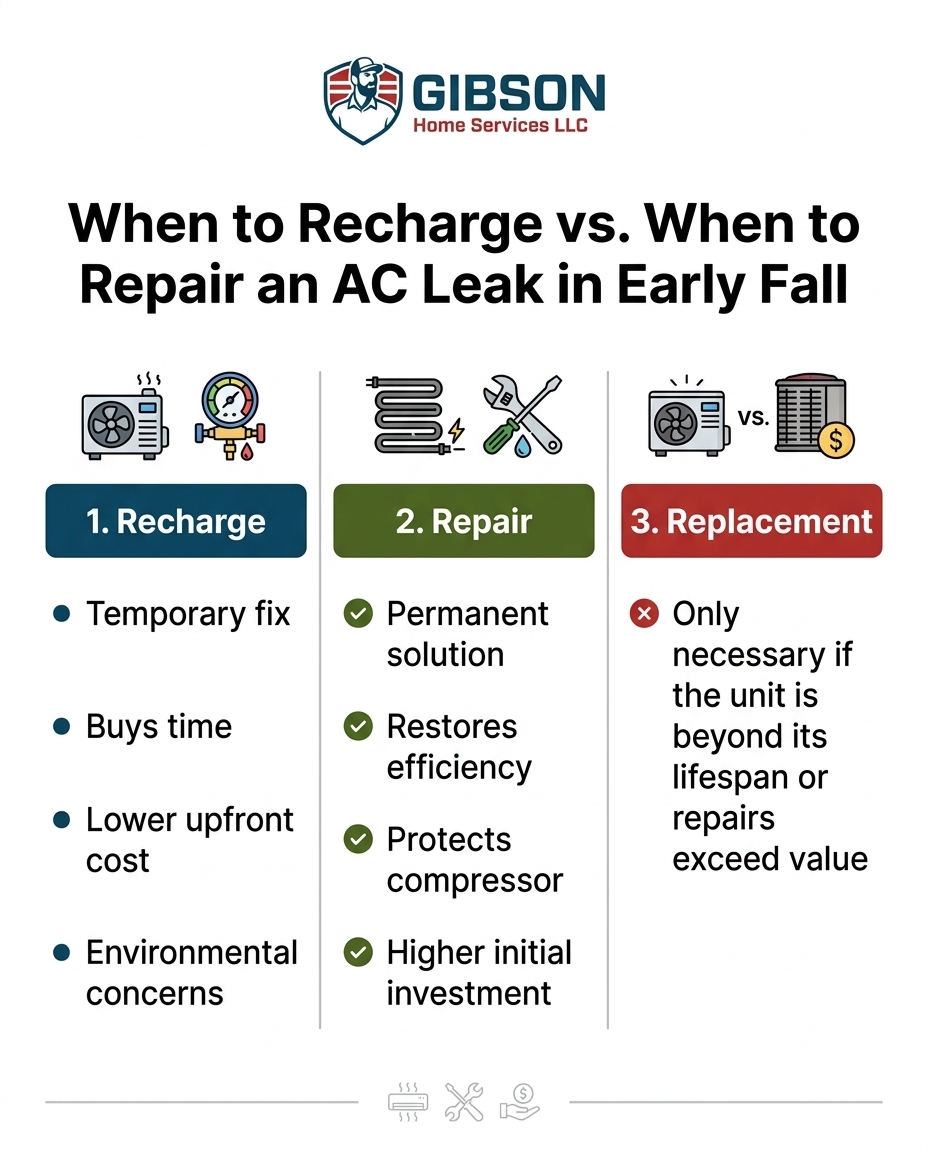
Side-by-Side Comparison: Recharge vs. Repair Before Winter
To help you make a definitive choice, here is a direct comparison of how our team views these options stacking up against each other. Keep in mind that if your system is severely aged or uses obsolete refrigerant, a full air conditioning replacement might genuinely be the most practical long-term path, especially since generic federal tax credits or local utility incentives may apply to qualifying high-efficiency upgrades.
• Immediate Comfort Impact — Recharging the Freon: Restores cooling temporarily — Repairing the Coil: Restores cooling permanently — Full System Replacement: Maximum comfort and humidity control
• Long-Term Reliability — Recharging the Freon: Very low (will leak again) — Repairing the Coil: High (fixes the root cause) — Full System Replacement: Highest (brand new warranty)
• Risk Factors — Recharging the Freon: Compressor damage if it leaks out unnoticed — Repairing the Coil: Other aging parts might still fail later — Full System Replacement: Requires a larger upfront investment
• Best Used When... — Recharging the Freon: You only need to survive a few more warm weeks before a planned upgrade next spring. — Repairing the Coil: The AC is under 10 years old and the rest of the system is in excellent shape. — Full System Replacement: The unit is 15+ years old, uses obsolete R-22, or has multiple failing components.
Preparing Your HVAC System for the Seasonal Transition
Resolving your AC issues before winter does more than just keep you comfortable today; it prevents nasty surprises when turning the system back on in spring. When our technicians perform fall tune-ups, we remind homeowners that central HVAC systems share critical components. The blower motor that pushes cold air through your home in the summer is the exact same motor that pushes warm air from your furnace in the winter.
If a leaking AC coil causes ice to form and restrict airflow, it puts immense strain on that shared blower motor. Addressing the leak now ensures that the mechanical components are in prime condition for the heating season. Furthermore, indoor air quality is heavily impacted by a properly functioning system as windows stay closed for the fall. A clean, repaired evaporator coil prevents moisture buildup and mold growth inside your ductwork.
This is exactly why the team at Gibson Home Services strongly emphasizes proactive care over reactive emergency calls. Scheduling a comprehensive system check before switching over to the furnace or heat pump ensures a smooth September and early fall transition. Investing in routine HVAC maintenance allows our professionals to clean the burners, check the heat exchanger, and verify that the lingering AC issues will not haunt you next year.
Common Questions About Late-Season AC Leaks
Is it worth fixing an AC leak at the end of summer?
The short answer we give our customers is yes, provided the system is still in good overall condition. Fixing a leak at the end of summer protects the compressor from burning out and prevents moisture damage inside your ductwork. Even if you only use the AC for a few more weeks, leaving a system broken all winter often leads to worse mechanical failures when you try to start it up the following spring. A professional diagnostic will tell you if the repair makes long-term financial sense.
How long will an AC recharge last with a leak?
In our experience, a recharge can last anywhere from a few days to several months, depending entirely on the size of the hole. There is no way to guarantee how long the new freon will stay in the system. Micro-leaks might hold a charge for an entire season, while larger ruptures in the coil can vent the new refrigerant almost immediately. Because of this unpredictability, we always consider a recharge a temporary gamble rather than a fix.
Can you just add freon to a leaking AC?
Technically yes, but as certified professionals, we follow EPA guidelines that strongly discourage repeatedly venting refrigerants into the atmosphere. If the leak is severe, our technicians will recommend repairing the source rather than continually adding expensive freon to a failing loop.
Should I replace my AC if the coil is leaking?
Our technicians usually only recommend replacement if the unit is older than 12-15 years or uses obsolete R-22 refrigerant. For newer systems, replacing the damaged coil is almost always the more cost-effective route. The decision should be based on the overall age, the condition of the compressor, and your long-term plans for the home, rather than just the presence of a leak.
Why do AC coils suddenly start leaking?
We frequently find that coils leak due to corrosion caused by volatile organic compounds (VOCs) in the home's air. Over time, everyday household chemicals, cleaners, and aerosols react with the condensation on the copper coils, creating formicary corrosion. This corrosion eats microscopic holes through the metal. Lack of maintenance and dirty air filters can accelerate this process by trapping moisture and debris against the coil.
How does a second opinion work for HVAC replacement quotes?
When you call Gibson Home Services for a second opinion, it involves our certified technician performing a fresh, objective diagnostic on your system. You simply call our local team, explain that you have been quoted for a major repair or replacement, and ask us to verify the findings. We will test the system from scratch, show you the data, and provide a clear breakdown of all your options without any high-pressure sales tactics.
Make an Informed Decision With a Trusted Second Opinion
The right choice between repairing and recharging depends entirely on the specific condition of your unit, the size of the leak, and your long-term goals for the home. We believe you do not have to accept a rushed, high-pressure quote just because the weather is changing. Getting a clear, objective breakdown from our team gives you the confidence to reject aggressive sales tactics and choose the path that actually makes sense for your budget.
If you are dealing with a late-season breakdown in Delran NJ or the surrounding areas, do not guess at the solution. Reach out to our local experts at Gibson Home Services for an honest evaluation. We are here to provide the transparent diagnostics and reliable guidance you need to make the smartest decision for your home before winter arrives.
Latest articles
Discover more articles

Upgrading to a Variable-Speed Blower vs. Single-Stage for Better Fall Humidity Control
If your house feels cold but clammy during mild autumn weather, your AC might be short-cycling. See why upgrading your blower motor solves this sticky problem.
Can I Get a 24/7 Heat Pump Repair on a Weekend in Marlton?
When your system fails on a Friday night, you need to know if an emergency call means a real fix or just a patch. Find out what a weekend service call actually covers.
The Truth About Dead Compressors and Aggressive Replacement Quotes
A sudden AC breakdown is stressful when a technician immediately condemns your entire system. Before signing a replacement contract, see why a 'dead' compressor might just be a minor electrical issue.