
Why Your AC is Running but Not Cooling After a September Power Surge
Severe late-summer storms can leave your indoor fan running while the outdoor compressor fails. Find out how dual run capacitors handle power spikes and the safest way to restore your home's cooling.

The Deceptive Breeze: When Your AC Runs but Blows Warm Air
You walk into your living room expecting relief from the muggy heat, but instead, you are left wondering why your AC is running but not cooling after a September power surge. The vents are blowing air, the thermostat is set correctly, and the indoor fan hums along just like it always does. Yet, the temperature inside your home refuses to drop, and the air circulating feels heavy and warm.
This frustrating scenario is a common aftermath of severe weather, leaving homeowners confused about what exactly went wrong when the lights flickered and the power abruptly returned.
If you are dealing with this exact issue right now, having our team at Gibson Home Services LLC inspect your air conditioning system is the safest and fastest way to restore your home's comfort.
Diagnosing the Immediate Symptoms
When September late-summer thunderstorms roll through the region, they bring a high risk of electrical instability. If your system was running during a storm and suddenly stopped cooling, the symptoms can be incredibly deceptive. The indoor blower motor is designed to circulate air throughout your ductwork, and it requires relatively little electricity to do so. Because this fan is still operating, your system sounds like it is working perfectly.
However, the core cooling mechanism located in your outdoor condenser unit has likely been compromised. The delicate electrical balance required to compress refrigerant and remove heat from your home has been interrupted. While the indoor blower continues to push air, it is simply recycling the warm air already trapped inside your house.
The critical takeaway: This specific symptom requires professional high-voltage diagnosis. Resetting your circuit breaker might seem like the logical first step, but if a vital electrical component has absorbed a massive voltage spike, a simple reset will not bring your cooling back online. Understanding exactly how these storms interact with your equipment is the first step toward a permanent solution.
How Severe Weather Events Threaten Your HVAC System
To understand why your equipment failed, it helps to look at the environment surrounding it. In our experience providing HVAC services throughout the Delran NJ area, we often see how volatile storm fronts in late summer mix lingering heat with cooler autumn air. This atmospheric collision increases the risk of severe lightning and widespread grid surges.
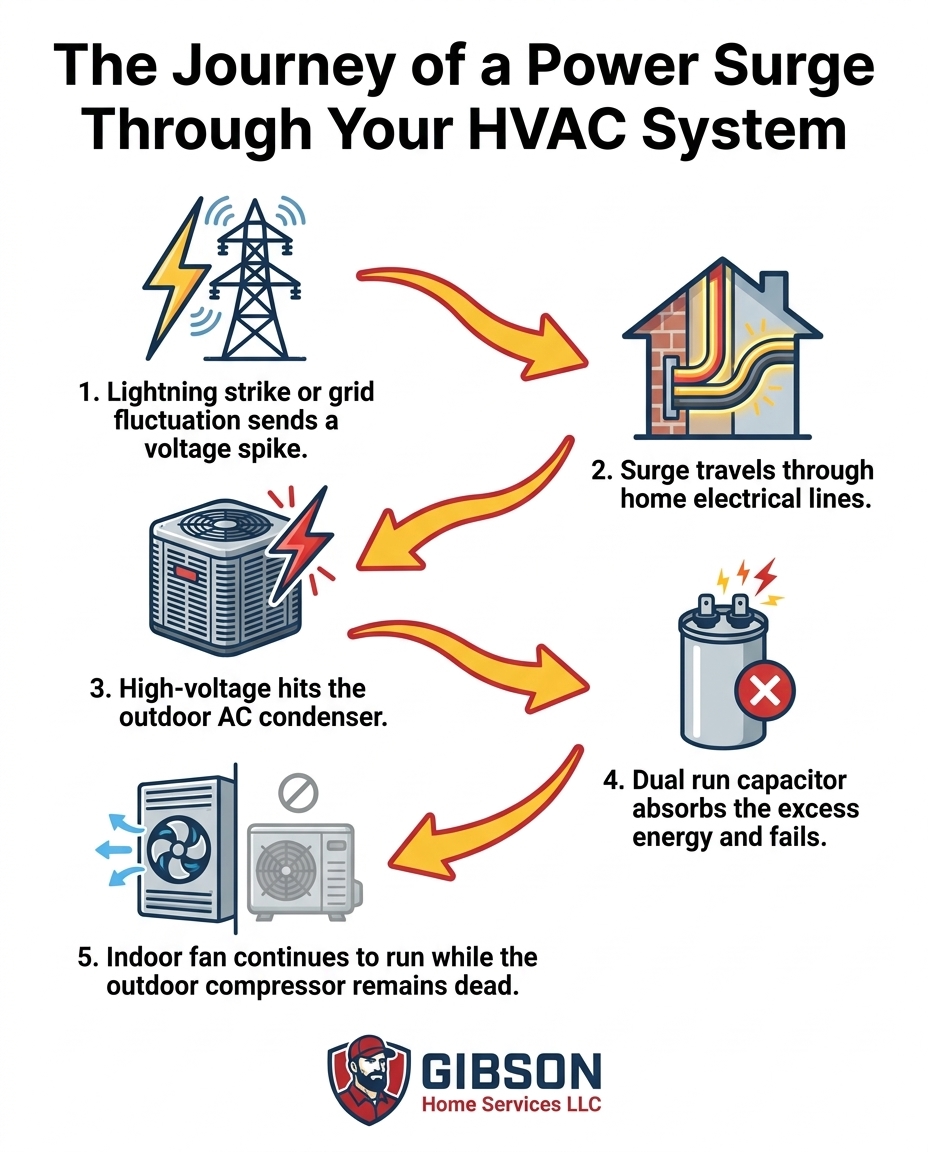
A power surge is not just a brief loss of electricity; it is a violent electrical event. When lightning strikes near power lines, or when the local utility grid fluctuates heavily during a storm, a massive voltage spike is sent rushing through your home's electrical lines in a fraction of a second. High-draw appliances, particularly your HVAC system, are exceptionally vulnerable to these sudden electrical fluctuations.
Understanding Electrical Disturbances
Many homeowners we speak with in the Delran NJ area assume that any power interruption is basically the same, but our technicians know firsthand that different electrical events impact your system in drastically different ways. Here is how they compare:
• Power Outage — What Happens: A complete loss of electrical voltage from the grid. — Impact on Your HVAC System: System shuts down safely. Usually restarts normally once power is restored.
• Brownout — What Happens: A temporary drop in voltage, causing lights to dim. — Impact on Your HVAC System: Forces motors to pull more amps to compensate, leading to overheating and excess wear.
• Power Surge — What Happens: A sudden, massive spike in electrical voltage. — Impact on Your HVAC System: Overwhelms sensitive electronics and instantly destroys components like capacitors and contactors.
When a surge hits, the excess energy races through your wiring looking for a place to ground itself. The outdoor air conditioning unit, which requires a substantial amount of electricity to operate, often becomes the unintended recipient of this destructive energy. This is why you might need our professional air conditioning repair in Delran even if the rest of the appliances in your home seem completely unaffected by the storm.
The Dual Run Capacitor: Your Air Conditioner's Heavy Lifter
When one of our Gibson Home Services LLC technicians arrives to diagnose a system that runs but fails to cool after a storm, the very first component we check is the dual run capacitor. To understand why, you need to know what this small but mighty device actually does.
A dual run capacitor is a powerful, battery-like component housed inside your outdoor condenser unit. Its primary job is to store electrical energy and release it in a concentrated burst to jump-start the outdoor equipment. Your air conditioner's compressor requires up to three times more energy to start than it does to keep running. The capacitor provides that essential initial torque.
Why is it Called "Dual"?
It is called a "dual" run capacitor because it actually powers two separate motors simultaneously. It has three terminals on top:
• C (Common): The grounding connection that completes the circuit.
• HERM (Hermetically Sealed Compressor): The terminal that sends the massive jolt of energy needed to start the compressor.
• FAN (Condenser Fan): The terminal that powers the fan blade pulling air across the outdoor coils.
Because these capacitors are constantly storing and releasing high levels of energy, they are highly sensitive to voltage spikes. When those September late-summer thunderstorms send a surge through your home, the capacitor acts like a sponge, absorbing the excess voltage to protect the more expensive compressor motor. The surge literally cooks the chemical fluid inside the capacitor, causing the top of the cylinder to bulge, leak, or fail entirely.
When the capacitor blows, the compressor cannot start. This failure can sometimes trigger other systemic stresses, which is why comprehensive system checks are vital. A blown capacitor might seem like an isolated incident, but it can occasionally be the hidden reason why your AC is leaking water if the indoor coil freezes up due to the lack of proper refrigerant flow.
The Disconnect: Why the Indoor Fan Outlasts the Outdoor Compressor
The most confusing part of a surge-related breakdown is the disconnect between the indoor and outdoor equipment. If the system was damaged, why is the indoor fan still blowing air?
The answer lies in how your heating and cooling system is wired. Your HVAC system is not a single appliance; it is a split system consisting of separate indoor and outdoor components, and they operate on completely different electrical circuits.
Two Separate Circuits, One Shared Thermostat
Your indoor air handler (the unit containing the blower fan) typically operates on a standard 120-volt circuit. It is sheltered deep inside your home, often protected by the breaker panel's internal distribution. Your outdoor condenser, however, requires a dedicated 240-volt circuit to handle the heavy lifting of the compressor.
When a surge strikes the Delran NJ area, it frequently travels straight from the grid to the outdoor disconnect box, frying the outdoor capacitor while leaving the indoor 120-volt circuit completely untouched.
The result? Your thermostat sends the signal to cool. The indoor fan successfully turns on, pulling warm air from your living room and blowing it back out through the vents. But because the outdoor compressor is dead, no heat transfer occurs. The refrigerant isn't circulating, and the air remains warm.
We recently had a local homeowner reach out to Gibson Home Services LLC when their AC decided to break during a sudden warm spell, leaving the home completely uncomfortable as the indoor fan just blew hot air around. Because our service technician was prompt, courteous, and professional, the underlying electrical disconnect was quickly diagnosed and fixed. The home was cooled off and comfortable again in no time, proving that this alarming symptom has a very straightforward mechanical cause.
A vital warning from our team: If you notice your vents blowing warm air, turn your thermostat to "OFF" immediately. Continuing to run the indoor fan while the outdoor unit is dead wastes significant energy and can cause further wear on the blower motor.
The Hidden Dangers of DIY Electrical Troubleshooting
When your home is uncomfortably warm and you suspect a blown capacitor, it is tempting to head outside, open the access panel, and take a look for yourself. However, inspecting and replacing high-voltage HVAC components is not a weekend DIY project. It carries severe, potentially life-threatening risks.
Dual run capacitors are specifically designed to store lethal amounts of high-voltage energy. Even when you pull the disconnect block and shut off the main power to the unit at your breaker panel, the capacitor remains fully charged. It acts like a loaded spring, holding thousands of volts of electricity just waiting for a path to ground.
Safety Protocols and Professional Requirements
Because of the extreme dangers involved, our professional technicians follow strict safety protocols that cannot be replicated without specialized training and equipment. Here is why our team insists you must leave this repair to an expert:
1. Visual inspections are highly deceptive. While a severely damaged capacitor might bulge at the top or leak an oily fluid, a capacitor can also fail internally while looking completely pristine on the outside. You cannot diagnose a capacitor just by looking at it.
2. Specialized testing tools are mandatory. Technicians use specialized multimeters with capacitance settings to measure the exact microfarads the component is producing. Standard household voltage testers cannot safely or accurately perform this task.
3. Discharging requires exact procedures. Before a capacitor can be safely removed, it must be manually discharged using an insulated tool to release the stored energy safely. Doing this incorrectly can cause serious injury or spark an electrical fire.
4. Sizing is an exact science. Installing an incorrectly sized capacitor (even by a few microfarads) will permanently destroy your compressor motor over time. The system might turn on initially, but the incorrect voltage will cause the motor windings to overheat and melt.
After those intense September late-summer thunderstorms, the absolute safest immediate action you can take is turning your thermostat to the "off" position and calling our licensed professionals for a proper diagnostic visit.
Restoring Comfort: The Value of Prompt Emergency Service
A sudden loss of cooling requires an immediate response. When your home loses its ability to condition the air, indoor humidity levels spike rapidly, making the air feel thick and uncomfortable. Heat buildup can damage sensitive electronics, warp hardwood floors, and make sleeping nearly impossible.
Because severe weather doesn't wait for convenient business hours, having access to a team that offers 24-hour emergency AC repair availability is crucial. Surge-related failures often happen in the middle of the night or on weekends, and you shouldn't be left stranded waiting for Monday morning to roll around.
What to Expect from an Emergency Diagnostic
When facing emergency situations like these, reliable support makes all the difference. For example, one single mom recently reached out to Gibson Home Services LLC for an emergency call when her air conditioner needed unexpected servicing. Our technician provided prompt, emergency service, explained the AC details thoroughly, and even showed her how to change the filter properly. That level of transparency and prompt action built trust that resulted in reliable AC service for the next five years.
When one of our professionals arrives at your home in the Delran NJ area to address a surge issue, they come prepared. Our technicians carry a wide range of universal and OEM (Original Equipment Manufacturer) capacitors directly on their trucks. This means that a blown capacitor can almost always be resolved on the very first visit.
Furthermore, we won't just swap the part and leave. We will perform a full diagnostic check to ensure no other components were compromised. We inspect the contactor for pitted or scorched metal, test the compressor windings for electrical shorts, and verify that the indoor blower motor is pulling the correct amperage. If you need emergency AC repair in Moorestown or the surrounding communities, this comprehensive approach guarantees your system is truly safe to operate again.
Securing Your System for the Fall Transition
A blown capacitor is often a wake-up call to evaluate the overall health of your HVAC system, especially as the cooling season begins to wind down. Those lingering September late-summer thunderstorms signal that autumn is approaching, making this the perfect time to let our team secure your equipment for the seasonal transition.
Surge damage proves just how vulnerable sensitive electrical components really are. Rather than waiting for the next storm to knock out your cooling—or worse, your heating system in the dead of winter—taking proactive steps now will save you from future headaches.
Your Pre-Fall HVAC Protection Checklist
To shield your system from future electrical anomalies and ensure it is ready for the colder months ahead, consider the following proactive measures we highly recommend:
• Invest in whole-home surge protection: Unlike small power strips used for televisions, a whole-home surge protector is installed directly at your main electrical panel. It acts as a gatekeeper, intercepting massive voltage spikes and safely redirecting them into the ground before they ever reach your HVAC equipment.
• Schedule a comprehensive pre-fall tune-up: Transitioning your system safely from cooling to heating requires a thorough inspection. One of our technicians will clean the outdoor coils, check the furnace burners, and ensure all electrical connections are tight and secure.
• Test your heating components early: Don't wait for the first freezing night to discover your heating cycle was damaged by a summer surge. A fall tune-up verifies that the reversing valve (for heat pumps) or the furnace ignition sequence is operating flawlessly. Note that federal tax credits may apply to qualifying high-efficiency heat pump installations, so check with your tax professional if you're considering an upgrade.
• Replace worn contactors: If a surge damaged your capacitor, the electrical contactor (the switch that turns the outdoor unit on and off) likely took a hit as well. Replacing pitted contactors proactively prevents the compressor from getting stuck in the "on" position.
Proactive maintenance catches weakened components before they fail entirely, ensuring your home remains comfortable regardless of what the weather brings.
Get Your System Back on Track with Expert Diagnosis
Dealing with a malfunctioning air conditioner is stressful, especially when the system sounds like it is running but fails to deliver any actual comfort. However, it is reassuring to know that a blown dual run capacitor is a very common, highly solvable issue following a severe storm in the Delran NJ area.
You do not have to live with a warm, humid house or worry that your entire system needs to be replaced. A clear, jargon-free explanation from our trusted team at Gibson Home Services LLC brings peace of mind and a swift resolution to the problem. By relying on our expert diagnosis and safe, precise repairs, you can get your system back on track and enjoy a comfortable home once again.
Frequently Asked Questions
Can a power surge ruin an air conditioner?
Yes, a severe power surge can cause significant damage to an air conditioner. The sudden spike in voltage easily overwhelms sensitive electrical components, most commonly destroying the dual run capacitor or the electrical contactor. In extreme cases, a massive surge can melt the wiring inside the compressor motor, which ruins the unit and requires a major repair or total replacement.
How do I reset my AC after a power surge?
To safely reset your system, start by turning your thermostat to the "off" position. Next, locate your home's main electrical panel and flip the dedicated circuit breaker for the air conditioner completely off, wait about one full minute, and then firmly flip it back on. Finally, turn your thermostat back to the cooling mode; if the system still blows warm air or fails to turn on, a component has likely failed and requires a professional technician from our team.
Why is my indoor AC fan running but the outside unit is off?
This happens because your HVAC system operates on two separate electrical circuits. The indoor fan usually runs on a standard 120-volt circuit, while the outside condenser relies on a dedicated 240-volt circuit. If a surge damages the outdoor unit's capacitor or trips its specific breaker, the outdoor compressor will remain dead while the indoor fan continues to circulate uncooled air through your vents.
What happens when an AC capacitor blows?
When a capacitor blows, it loses its ability to store and release the electrical energy required to start the outdoor motors. You will typically hear a humming or clicking sound coming from the outdoor unit as the compressor struggles to turn on, but the fan blades will not spin. Because the compressor cannot start, the system loses its ability to cool the air, resulting in warm air blowing inside the house.
Can a power surge damage my AC capacitor specifically?
Yes, the dual run capacitor is usually the very first component to fail during a power surge. Because its primary function is to store high amounts of electrical energy, it acts like a sponge when a voltage spike hits the system. The excess electricity overheats the chemical fluids inside the capacitor, causing it to bulge, leak, or rupture entirely to protect the more expensive compressor motor.
How quickly can a technician safely replace a blown capacitor after a storm?
A licensed professional from Gibson Home Services LLC can typically diagnose and replace a blown capacitor in less than an hour once they arrive at your home. Because capacitor failure is the most common issue following severe weather, our technicians carry a wide variety of universal and OEM replacement capacitors on our service trucks. This allows us to safely discharge the old unit and install the correct replacement on the very first visit.
Latest articles
Discover more articles

How Rapidly Switching Between Heat and Cool Modes Damages Your Reversing Valve
Crisp fall mornings and warm afternoons make it tempting to constantly flip your thermostat. Giving your heat pump a brief rest between cycles prevents system lockouts and costly valve damage.
Why Your AC is Running but Not Cooling After a September Power Surge
Severe late-summer storms can leave your indoor fan running while the outdoor compressor fails. Find out how dual run capacitors handle power spikes and the safest way to restore your home's cooling.
Upgrading to a Variable-Speed Blower vs. Single-Stage for Better Fall Humidity Control
If your house feels cold but clammy during mild autumn weather, your AC might be short-cycling. See why upgrading your blower motor solves this sticky problem.