
Who Do I Call for 24-Hour Emergency AC Service in Medford When It's Raining?
Losing your AC during a heavy fall downpour creates a stressful dilemma. Understand what emergency technicians can safely diagnose indoors and why outdoor repairs must wait.

Losing Air Conditioning During a Downpour: What Are Your Immediate Options?
Is your system acting up right in the middle of a storm, leaving you wondering: Who Do I Call for 24-Hour Emergency AC Service in Medford When It's Raining? It is incredibly frustrating when your air conditioner or heat pump decides to fail just as a heavy, early-fall weather system rolls in. The humidity inside your house starts climbing immediately, and your first instinct is to get a professional out to your property right this second. At Gibson Home Services, our dispatchers hear this panic frequently. However, a sudden AC failure during heavy rain presents a unique concrete problem for homeowners. You are faced with a critical decision point: do you demand immediate outdoor dispatch from whoever answers the phone first, or do you take a moment to understand the strict safety protocols that dictate what can actually be fixed during a downpour?
When you need reliable Air Conditioning Services, you deserve a team that balances your urgent need for comfort with uncompromising safety standards. Our true professionals are available around the clock, but we also know the critical difference between safe indoor diagnostics and hazardous outdoor electrical repairs.
The Electrocution Hazards of Outdoor AC Repair in the Rain
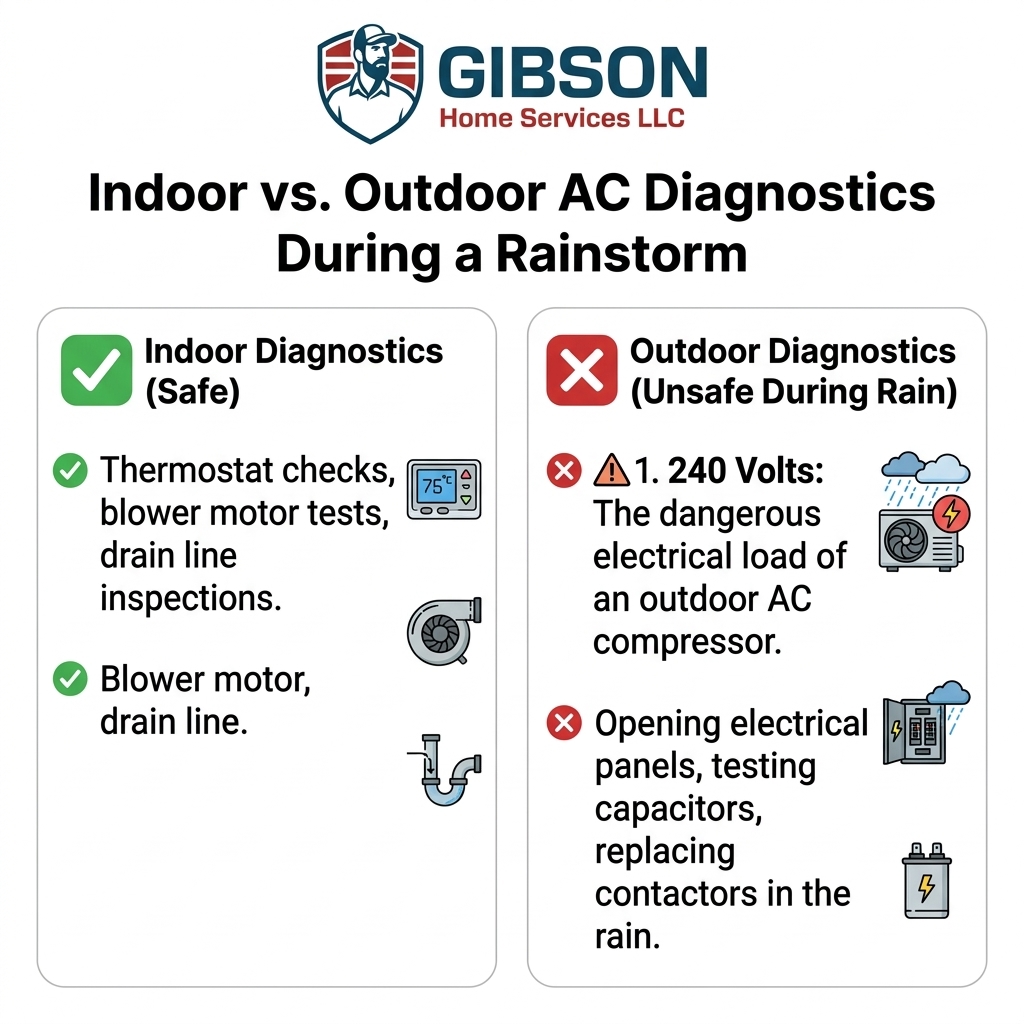
Your outdoor air conditioning unit, known as the condenser, is a heavy-duty piece of equipment. It operates on 240 volts of electricity to power the compressor and the large fan motor. Under normal, dry conditions, our trained technicians safely open the electrical panels to test components. However, when water enters the equation, that 240-volt electrical load becomes an extreme hazard.
General HVAC industry safety standards and strict OSHA guidelines prohibit technicians from working on live, high-voltage electrical panels in wet conditions. Water is a highly effective conductor of electricity. If a technician opens the sealed electrical compartment of your outdoor unit while it is actively raining, they are exposed to severe electrocution risks.
Furthermore, rainwater compromises the diagnostic process itself. A technician cannot safely or accurately test capacitors, contactors, or the compressor when everything is wet. Moisture can cause multimeters to display false readings, leading to incorrect diagnoses and wasted money. If you reach out for 24-hour AC repair in Medford and a contractor promises they will instantly fix your outdoor unit in the middle of a torrential downpour, they are compromising basic safety protocols. Our reputable technicians at Gibson Home Services will never put their lives, or your expensive equipment, at risk just to make a quick repair during a storm.
• Dry Weather — Safety Status: Safe for all repairs — Why It Matters: Panels can be opened, and 240V components can be accurately tested with dry multimeters.
• Light Drizzle — Safety Status: Caution required — Why It Matters: Technicians may use protective cover, but live electrical testing is still heavily restricted.
• Active Downpour — Safety Status: Extremely Hazardous — Why It Matters: OSHA guidelines prohibit live electrical work. High risk of electrocution and false diagnostics.
What an Emergency Technician Can Safely Diagnose Indoors
Just because it is pouring rain outside does not mean you have to sit and wait helplessly. A 24/7 emergency service call is still highly valuable during a storm because a central air conditioning system is split into two halves. While the outdoor condenser is off-limits during the rain, the indoor components are completely protected from the weather. In our experience, many common AC failures actually originate inside the house, meaning our emergency technicians can get to work immediately.
By dispatching a professional right away, you get a head start on the diagnostic process. If the issue is indoors, we can often resolve it before the storm even passes. If the issue is outdoors, our technicians can secure the indoor system, check your indoor air quality, and prep everything so the outdoor repair can happen the exact minute the weather clears.
Thermostat and Control Wiring
Your thermostat acts as the brain of your HVAC system. Our technicians can safely verify if the thermostat is sending the correct low-voltage signals to the cooling equipment. We can check the indoor wiring, recalibrate the sensors, and ensure that a blank screen isn't just a simple indoor control failure.
Air Handler and Blower Motor
The indoor unit, typically located in a basement, attic, or utility closet, houses the blower motor and the evaporator coil. Technicians can fully access, test, and repair these components regardless of the outdoor weather conditions. We can check the blower motor's operation, inspect the indoor electrical panels for tripped breakers, and verify that the indoor coil isn't frozen over.
Condensate Drain Lines
During highly humid, early-fall rainy weather, your AC pulls gallons of moisture out of your indoor air. This water drains out through the condensate line. If this line clogs, safety switches will shut the entire system down to prevent your home from flooding. A technician can safely clear these clogs indoors. If you notice pooling water near your indoor unit, understanding Why Your AC Is Leaking Water is a crucial part of the indoor diagnostic process we perform.
Why Early Fall Rainstorms Cause Sudden AC Failures
Weather plays a massive role in how your HVAC system performs, especially during transitional seasons. In our years of servicing HVAC systems throughout the Delran and Medford areas, we've noticed a distinct pattern. Early fall rainstorms frequently bring remnant tropical moisture, heavy downpours, and sudden temperature shifts. These specific weather events create a perfect storm for sudden air conditioning and heat pump failures right when you should be scheduling a pre-heating season tune-up.
First, heavy winds and driving rain can blow excessive debris, such as wet fall leaves, twigs, and dirt, directly into the outdoor condenser. This debris obstructs the vital airflow needed to dissipate heat, causing the system to overheat and shut down on a high-pressure safety limit. The fan blades can also become unbalanced or damaged by flying branches during a severe squall.
Second, these early fall rainstorms are often accompanied by intense lightning and power grid fluctuations. A sudden electrical surge can travel straight to your outdoor unit, instantly frying sensitive components like the dual run capacitor or the contactor. When this happens, you might hear a buzzing sound from the unit, but the fan and compressor will refuse to start. (If storm damage requires a full system replacement, generic federal tax credits and local utility incentives may apply to qualifying high-efficiency heat pump installations, though you should always verify current programs with your tax professional).
Finally, the sheer volume of moisture in the air puts a heavy load on the equipment. High humidity combined with heavy rain can overwhelm a system that was already struggling at the end of a long, hot summer season. The system runs longer cycles to try and dehumidify the house, which can push an aging blower motor or a weak capacitor past its breaking point right in the middle of the downpour.
Steps to Protect Your AC System While Waiting for the Weather to Clear
If your system fails during a storm, your first priority is protecting the equipment from further damage while you wait for a technician to arrive. Taking the right steps ensures that a minor electrical issue doesn't turn into a major compressor failure.
One local single mother experienced this exact situation when her air conditioner needed emergency service during a sudden storm. She was panicked about the indoor humidity and the safety of her system. She reached out to us at Gibson Home Services, and our technician responded within hours to secure the indoor unit. We clearly explained the maintenance needed and why the outdoor work had to wait for the storm to pass. Because our team communicated the safety protocols clearly, she felt completely informed, trusted the process, and had her system fully restored the moment the weather safely cleared.
Here is what our team recommends you do if your system stops working in the rain:
1. Turn off the thermostat: Switch your thermostat from "Cool" to "Off." If the outdoor unit is short-cycling or struggling to start due to a fried capacitor, leaving it on will cause the compressor to overheat and potentially burn out.
2. Stay inside: Do not go outside in the rain to inspect the condenser. Do not touch the outdoor electrical disconnect box. Water and high voltage are a deadly combination.
3. Document the symptoms: Write down exactly what happened. Did the lights flicker before it died? Is there a burning smell near the indoor vents? Did you hear a loud buzzing noise from outside? This information is incredibly helpful for our dispatchers.
4. Check your indoor breaker: You can safely look at your indoor electrical panel to see if the breaker labeled "AC" or "HVAC" has tripped. If it has, leave it off. A tripped breaker during a storm usually indicates a power surge or a short circuit that a professional needs to investigate.
5. Call for emergency service: Reach out to a responsive emergency technician. Clear communication is key. A good technician will keep you informed, start the indoor diagnostics immediately, and monitor the weather radar to find a safe window for outdoor work.
Choosing a Medford HVAC Contractor Who Prioritizes Safety and Integrity
When you are dealing with a stressful breakdown during a storm, the contractor you choose matters immensely. True professional integrity means protecting homeowners. It means a company will not risk electrical hazards or misdiagnose wet components just to collect an emergency fee.
At Gibson Home Services, we enforce strict safety protocols and prioritize professional integrity above all else. We prove our commitment to you by doing the job safely and correctly, rather than making reckless, unsafe dispatch promises that put people and property at risk. A reputable company providing Medford AC service will always dispatch a technician to secure your indoor unit, diagnose what they safely can, and then schedule the outdoor repair for the exact moment the weather permits.
Contrast this with contractors who overpromise and underdeliver during severe weather events. If a company claims they will rebuild your 240-volt outdoor electrical panel in the middle of a torrential downpour, they are not looking out for your best interests. Prioritizing safety ultimately results in a more accurate, lasting repair once the rain stops, saving you from repeat breakdowns and unnecessary expenses.
Frequently Asked Questions About Wet Weather AC Emergencies
Can an HVAC technician work in the rain?
Technicians can safely work on indoor components like thermostats, air handlers, and ductwork during the rain. Because the system is split, much of the diagnostic process can happen safely inside your home. However, our technicians cannot safely open 240V outdoor electrical panels due to severe electrocution risks and strict OSHA regulations. Any outdoor electrical work must be paused until the rain stops and the equipment is dry enough to test safely.
Is it safe to run my AC in heavy rain?
Yes, outdoor AC units are designed and built to withstand rain, wind, and normal weather conditions. The internal electrical components are housed in weather-resistant compartments. However, if the unit begins making strange grinding or buzzing noises, trips your indoor circuit breakers, or fails to cool the house during a storm, you must turn it off immediately at the thermostat. Running a damaged system during a storm can lead to catastrophic compressor failure.
Why did my AC stop working after a rain storm?
Power surges from lightning are a leading cause of AC failure during and immediately after a storm. These surges can instantly damage sensitive electrical components like capacitors and contactors. Additionally, heavy winds often blow early-fall leaves, dirt, and debris into the outdoor unit, restricting the necessary airflow and causing the system to overheat or trigger internal safety shutoffs.
Can you fix an air conditioner in the rain?
Indoor fixes can be completed immediately, regardless of what the weather is doing outside. If your problem is a clogged condensate drain line, a bad thermostat, or a tripped indoor safety switch, our technicians can resolve it during the storm. Outdoor fixes, however, must wait until the rain stops. The equipment must be safe to test without water interference to ensure an accurate diagnosis and protect the technician from high voltage.
Should I cover my outdoor AC unit during a storm?
No, you should never cover your outdoor AC unit while it is running, and covering it during a rainstorm is unnecessary. The equipment is built to handle normal precipitation without a cover. Covering the unit can actually trap moisture inside, restricting necessary airflow and leading to accelerated rust, mold growth, and mechanical failure. Let the unit breathe exactly as the manufacturer intended.
Get Safe, Reliable Diagnostics When You Need Them Most
While the rain ultimately dictates the timeline for outdoor repairs, you absolutely do not have to wait to start the diagnostic process. Understanding the difference between safe indoor troubleshooting and hazardous outdoor electrical work empowers you to make smart decisions for your home. An honest explanation of safety protocols and realistic expectations is exactly what you should expect from a true professional.
When the early fall weather turns harsh and your system stops blowing cold air, taking immediate action protects your equipment from further damage. Reach out to Gibson Home Services for comprehensive indoor diagnostics right away, and secure priority scheduling so your outdoor repairs are completed safely and accurately the moment the storm clears.
Latest articles
Discover more articles

Who Do I Call for 24-Hour Emergency AC Service in Medford When It's Raining?
Losing your AC during a heavy fall downpour creates a stressful dilemma. Understand what emergency technicians can safely diagnose indoors and why outdoor repairs must wait.
How Rapidly Switching Between Heat and Cool Modes Damages Your Reversing Valve
Crisp fall mornings and warm afternoons make it tempting to constantly flip your thermostat. Giving your heat pump a brief rest between cycles prevents system lockouts and costly valve damage.
Why Your AC is Running but Not Cooling After a September Power Surge
Severe late-summer storms can leave your indoor fan running while the outdoor compressor fails. Find out how dual run capacitors handle power spikes and the safest way to restore your home's cooling.