
HVAC Contractor in Berlin, NJ

Facing a System Breakdown During Extreme Temperatures?
Winter in Berlin, NJ, brings harsh conditions with unexpected drops in temperature, just as summers bring oppressive humidity. When your heating or cooling system quits, you need a fast, reliable solution immediately—call us now to schedule an emergency diagnostic or to discuss financing options for a replacement.
Homeowners cannot afford to wait days for a technician when the indoor environment becomes unsafe or uncomfortable. You need a contractor who understands the urgency of a failed furnace in January or a frozen air conditioner in July:
- Rapid response teams available 24/7 for all heating and cooling emergencies.
- Experienced technicians ensuring same-day repairs and installations whenever possible.
- Transparent pricing with no hidden costs—get your free estimate now.
Fully licensed, insured, and with solid warranties on all our services for your peace of mind.
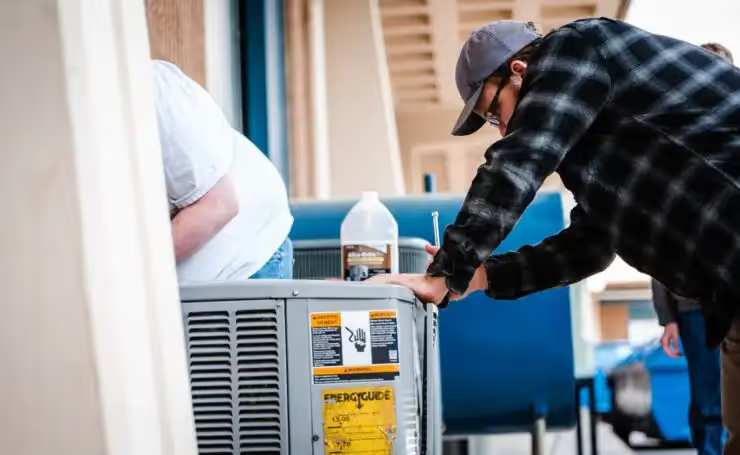
Immediate Response and Comprehensive Diagnostic Protocol
When you request service for a failing HVAC system, the immediate goal is to restore safety and comfort to your home. A professional contractor does not guess at the problem; they follow a strict diagnostic protocol to identify the root cause of the failure. This prevents "band-aid" fixes that result in recurring breakdowns later in the season.
Upon arrival, the technician begins a systematic review of the entire system. For heating issues, this involves checking the heat exchanger for cracks, testing the ignition system, and verifying that the blower motor is operating at the correct RPM. For cooling issues, the focus shifts to refrigerant levels, compressor amperage, and airflow restrictions.
Modern HVAC systems are complex networks of electrical, mechanical, and airflow components. A single failure in a capacitor or a sensor can shut down the entire unit. The diagnostic process includes:
- Electrical Component Testing: Technicians use multimeters to measure voltage and amperage across motors, capacitors, and control boards to ensure they fall within manufacturer specifications.
- Airflow Analysis: Static pressure tests reveal if the ductwork is restricting air, which can cause equipment to overheat or freeze.
- Safety Control Verification: Limit switches, pressure switches, and flame sensors are tested to ensure the system shuts down properly if a safety hazard is detected.
- Thermostat Calibration: Ensuring the interface that controls the system is reading the indoor temperature accurately.
Gibson Heating & Cooling prioritizes accurate diagnostics to provide homeowners with clear options: a definitive repair or a recommendation for replacement based on the severity of the issue.

The Professional Installation and Replacement Process
There comes a point where a system is too old or damaged to warrant further investment. Replacing an HVAC system is a major construction project that requires precise calculation and execution. It is not a simple "plug and play" appliance swap. The longevity and efficiency of your new unit depend entirely on the quality of the installation.
Load Calculation and Sizing
The process begins before the old unit is even removed. A correct installation starts with a Manual J load calculation. This engineering calculation considers the square footage of the home, insulation levels, window quality, and the orientation of the house relative to the sun. In Berlin, NJ, where temperature swings are significant, having a correctly sized unit is critical. An oversized unit will short-cycle, leading to humidity issues and premature wear, while an undersized unit will run continuously without ever reaching the set temperature.
Safe Removal and Disposal
Technicians must handle the removal of the existing equipment with care. This involves pumping down and recovering old refrigerant according to EPA regulations to prevent environmental contamination. Gas lines and high-voltage electrical connections are disconnected safely. The area is prepped, and the old unit is removed without damaging the surrounding property.
Installation of the New System
The installation phase involves several critical steps that define the performance of the system for the next 15 to 20 years:
- Equipment Placement: The new furnace, air handler, or condensing unit is leveled and secured. Vibration isolation pads are used to reduce noise transfer into the home structure.
- Ductwork Modification: The existing plenum (the transition between the unit and the ductwork) often needs modification to fit the new, more efficient equipment. Technicians seal these connections with mastic or metal tape to prevent air leaks.
- Line Set Brazing: Refrigerant lines connect the indoor and outdoor units. These copper lines are brazed using nitrogen purging techniques. This prevents oxidation inside the pipes, which acts as a contaminant that can destroy the new compressor.
- Electrical and Gas Connections: High-voltage wiring is connected and tested. For gas furnaces, leak detection fluids are used on all new gas piping connections to ensure absolute safety.
- Condensate Management: High-efficiency units produce significant water (condensate). New drains and pumps are installed to route this water away from the home’s foundation and prevent interior water damage.
Commissioning and Testing
The final step is commissioning. The system is not just turned on; it is tuned. Technicians adjust the blower speed to match the ductwork, verify the gas pressure at the manifold, and measure the subcooling and superheat of the refrigerant to ensure the charge is exact. This baseline performance is documented for warranty purposes.
Deciding Between Repair and Replacement
Homeowners often struggle with the financial decision of repairing an aging unit versus investing in a new system. Making the right choice requires analyzing the age of the equipment, the cost of the repair, and the potential energy savings of a new unit.
The 50% Rule
A common industry standard for decision-making is the 50% rule. If the cost of the repair approaches 50% of the value of the system (or the cost of a new system), replacement is generally the smarter financial move — view our current promotions.
Equipment Age and R-22 Phase Out
HVAC systems generally last between 12 and 15 years. If your system is approaching or exceeding this age, major component failures (like compressors or heat exchangers) signal the end of the unit's useful life. Additionally, older air conditioning units utilize R-22 refrigerant, which has been phased out environmentally. Repairs requiring R-22 are becoming prohibitively expensive due to scarcity. Upgrading to a system that uses R-410A or newer refrigerants resolves this supply issue and ensures future serviceability.
Frequency of Breakdowns
If you have required repairs more than twice in the last two years, the system is becoming unreliable. The cumulative cost of service calls, parts, and the inconvenience of downtime often outweighs the monthly cost of a new, financed system.
Energy Efficiency Considerations
Technology has advanced significantly in the last decade. Older standard systems often operate at 10-12 SEER (Seasonal Energy Efficiency Ratio). Modern systems start at 14-15 SEER and can go much higher. Replacing a 10 SEER unit with a 16 SEER unit can reduce cooling costs by 30-40%. In a climate with hot summers, these savings add up quickly, helping to offset the installation cost over time.
Local Factors Impacting HVAC Performance in Berlin, NJ
Operating an HVAC system in Camden County requires attention to specific regional factors. The local climate is classified as humid subtropical, meaning the equipment must handle high moisture loads in the summer and potential freezing conditions in the winter.
Humidity Control
Summer in New Jersey is defined by humidity. An air conditioner’s job is twofold: cooling the air and removing moisture. If a contractor installs a unit that is too large, it will cool the house too quickly and shut off before it has had time to dehumidify the air. This leads to a cold, clammy indoor environment and increases the risk of mold growth in ductwork. Proper sizing ensures long run times that effectively pull moisture out of the air.
Winter Freeze Protection
Winter temperatures in Berlin frequently drop below freezing. For homes utilizing heat pumps, this requires specific defrost control boards and backup heating elements (auxiliary heat) to maintain comfort during deep freezes. For gas furnaces, the venting must be inspected to ensure that snow accumulation or ice does not block the exhaust pipes, which would cause the system to shut down for safety reasons.
Permits and Compliance
HVAC work in Berlin, NJ, is subject to local building codes and permitting requirements. Professional contractors handle the administrative burden of filing for permits. This ensures that the installation meets all safety codes regarding gas piping, electrical wiring, and exhaust venting. Unpermitted work can cause issues when selling the home and may void manufacturer warranties — read our customer reviews.
Why Technical Expertise Matters for Long-Term Reliability
The HVAC industry is flooded with operators, but true reliability comes from technical depth and business stability. The difference between a system that lasts 10 years and one that lasts 20 years is often the quality of the maintenance and the precision of the installation.
Warranty and Accountability
A strong warranty is only as good as the company standing behind it. Established contractors offer labor warranties that complement the manufacturer's parts warranty. This protects the homeowner from out-of-pocket costs if a defect arises shortly after installation.
Stocked Mobile Warehouses
Efficiency in repair work relies on logistics. Service vehicles should function as mobile warehouses, stocked with universal parts like capacitors, contactors, ignitors, and motors. This allows technicians to complete most repairs in a single visit, restoring comfort immediately rather than waiting on parts orders.
Advanced Tools and Training
Modern high-efficiency systems communicate digitally. Technicians need advanced diagnostic tools to read error codes and program thermostats. Constant training is required to stay current with heat pump inverters, modulating gas valves, and smart home integration.
Securing Your Home Comfort
Your HVAC system is the heart of your home, essential for safety in the winter and relief in the summer. Whether you are facing an emergency breakdown or planning a proactive replacement, the choice of contractor dictates the future performance of your equipment.
Prioritize contractors who offer transparent diagnostics, adhere to local codes, and provide clear documentation of all work performed. Do not let a minor issue escalate into a major failure due to neglect or improper service.
Take control of your indoor climate today. Contact Gibson Heating & Cooling to schedule your service or consultation and ensure your home remains comfortable regardless of the weather outside.
our process
Our heating Process Section
01
Thorough Diagnosis/Consultation
We start with a comprehensive assessment of your needs.
02
Upfront & Honest Pricing
We provide a clear, detailed estimate before any work begins.
03
Professional
Schedule
Our certified technicians perform the work to the highest standards.
04
Final Inspection & Clean-up
We ensure everything is working perfectly and leave your home clean.
testimonials
The Customer Experience:
Where Comfort Meets Reliability.
Trusted by Homeowners Across Burlington County.
