
The Challenges of Retrofitting Modern Ductwork into 19th-Century Medford Homes
Upgrading your historic 1800s property for winter doesn't have to mean destroying original plaster walls. Explore non-invasive heating solutions that preserve your home's unique charm.

The Hidden Realities of Heating Historic Medford Homes Before Winter
The challenges of retrofitting modern ductwork into 19th-century Medford homes become painfully clear when the October chill sets in, and those stunning but drafty rooms refuse to hold heat. Your historic property offers incredible architectural charm, but its original framing and plaster walls were simply not designed to accommodate bulky modern HVAC systems. With Medford's freezing winters demanding robust, high-efficiency heating, you are faced with a critical decision. Do you attempt to force conventional metal ducts into fragile historic spaces, risking severe structural and aesthetic damage? Or do you explore modern, non-invasive alternatives that respect your home's heritage?
Before the October pre-winter heating startup window closes, exploring your options is essential. Whether you are considering Ductless Systems or planning a broader Air Conditioning Installation in Medford, understanding the hidden realities behind your walls is the first step toward reliable comfort that preserves your home's legacy.
Older homes inherently struggle to retain heat. The lack of modern insulation, combined with single-pane glass and settling foundations, means your heating system has to work significantly harder to maintain a comfortable temperature. When homeowners try to solve this by retrofitting standard forced-air systems, they quickly discover that the physical footprint of the ductwork is incompatible with the building's skeleton. The goal is to achieve powerful winter heating and reliable summer cooling without compromising the original charm that makes your property so special.
Why Standard Ductwork and 19th-Century Framing Don't Mix
To understand why standard sheet metal ducts are so destructive to older properties, you have to look at how these houses were built. The 19th-Century construction techniques used in our area are fundamentally different from modern building codes. The primary hurdle for any HVAC retrofit in an older home is the framing method itself.
Modern homes use "platform framing," where each floor is built as a separate platform, creating natural horizontal cavities between floor joists and vertical cavities within walls. This makes routing large metal trunks relatively straightforward. Historic homes, however, often utilize a technique known as balloon framing.
The Anatomy of Balloon Framing
In a balloon-framed house, the wooden wall studs run continuously from the foundation sill plate all the way up to the roofline. While this creates a very sturdy vertical structure, it presents massive challenges for modern heating retrofits.
• Continuous vertical channels: Because the stud bays run uninterrupted from the basement to the attic, they act like chimneys. This allows cold drafts to pull heat right out of your living spaces.
• Lack of horizontal pathways: There are no natural, unobstructed horizontal cavities to run a standard 8-inch or 10-inch metal duct across a ceiling or through a wall without cutting through critical load-bearing timber.
• Absence of firestops: Modern codes require horizontal fire blocking inside walls. Balloon frames lack this, meaning any invasive cutting for ductwork can compromise the structural integrity and fire safety of the entire wall assembly.
Cutting into these original, old-growth timbers to force a metal duct pathway is dangerous and often structurally prohibited. We see similar lateral architectural challenges when Managing HVAC Airflow in Older Cherry Hill Bi-Level Homes, where unique framing dictates the entire airflow strategy.
• 19th-Century Balloon Framing — Wall Cavity Structure: Continuous vertical studs from foundation to roof. — Impact on Ductwork Retrofits: Extremely difficult. Requires destructive cutting of load-bearing wood for horizontal runs.
• Modern Platform Framing — Wall Cavity Structure: Segmented by floor, with natural horizontal voids. — Impact on Ductwork Retrofits: Standard. Built-in chases and joist bays easily accommodate large metal trunks.
Because poorly routed conventional ducts in these tight, uninsulated spaces exacerbate heat loss, forcing standard equipment into a historic home often results in an inefficient system that constantly struggles to keep you warm.
The Fragility of Original Lath-and-Plaster Walls
Even if you could find a safe pathway through the balloon framing, the next major hurdle is the wall surface itself. The interior walls of Historic Medford, NJ homes are typically constructed using lath and plaster. This traditional method involves nailing thin, horizontal strips of wood (the lath) across the wall studs, and then troweling multiple coats of wet plaster over them.
As the plaster dries, it oozes between the wooden strips, forming "keys" that lock the rigid wall surface to the flexible wood behind it. This creates a beautiful, sound-dampening, and historically accurate finish. However, it is incredibly fragile when subjected to modern demolition.
Vibration Damage and Aesthetic Ruin
The mechanics of lath-and-plaster make it highly susceptible to the vibration and invasive cutting required for standard metal ducts. When a contractor uses a reciprocating saw to cut a large hole for a standard air register, the violent vibration shatters the plaster keys hidden behind the wall.
The cascading failure: Once the keys break, the heavy plaster separates from the lath. What starts as a small cut for a vent quickly turns into massive spiderweb cracks running across the entire room. In worst-case scenarios, large sheets of plaster can detach and fall off the wall entirely.
The aesthetic cost: Repairing authentic 19th-century plasterwork is a dying art. Replacing it with modern drywall destroys the historical accuracy of the room, ruins the alignment of original baseboards and crown molding, and permanently alters the home's character.
Hidden hazards: Disturbing older building materials during heavy demolition also introduces severe risks. Hidden layers of lead paint or asbestos-containing materials are common in older properties, making aggressive wall cutting a potential health hazard.
As preservation-first HVAC experts who deeply understand Medford's historic housing stock, our priority is structural respect. We know that preserving your original architectural trim and intact plaster walls is just as important as upgrading your heating system.
Non-Invasive Comfort: The Ductless Alternative
If tearing down walls and cutting into floor joists is off the table, how do you heat an older home efficiently? For many 19th-Century properties, the most effective preservation-friendly solution is a ductless mini-split heat pump.
Ductless systems operate exactly as their name suggests—they provide powerful heating and cooling without requiring expansive wall cavities, ceiling drops, or a network of hidden sheet metal. Instead of a central air handler pushing air through long, leaky ducts, these systems use a sleek outdoor compressor connected directly to individual indoor air handling units.
The zoning advantage: One of the greatest benefits of a ductless system is the ability to zone your heating. Drafty historic rooms often have wildly different temperature profiles. A room with large, original single-pane windows on the north side of the house will always be colder than a south-facing parlor. Ductless units allow you to customize the temperature in each specific zone, ensuring comfort exactly where you need it without overheating the rest of the house.
Year-round performance: Modern ductless heat pumps utilize advanced inverter technology, allowing them to extract heat from the outside air even when temperatures plummet well below freezing. This provides reliable winter heating, and with a simple switch of a reversing valve, the exact same system handles your summer cooling needs.
Because these systems only require a small, three-inch hole drilled through the exterior wall to connect the refrigerant lines and wiring, your original plaster and framing remain fully intact. Regular AC Service and maintenance keep these units running at peak efficiency year after year. Additionally, federal tax credits and utility incentives may apply to qualifying high-efficiency heat pump installations, making this upgrade an excellent long-term investment. We always advise readers to consult a tax professional or local utility provider to confirm current eligibility.
Small-Duct High-Velocity (SDHV) Systems for Seamless Integration
For homeowners who strongly prefer the aesthetics of a hidden central system but cannot accommodate traditional ductwork, Small-Duct High-Velocity (SDHV) systems offer a brilliant compromise. These systems are specifically engineered to achieve central heating and cooling without the destructive footprint of conventional metal ducts.
Instead of the massive 8-to-12-inch rigid metal trunks used in standard HVAC, an SDHV system uses flexible, insulated tubing that is typically only 2 inches in diameter. This dramatic reduction in size changes the entire installation strategy for Historic Medford, NJ properties.
How Flexible Tubing Protects Your Home's Integrity
The small, flexible nature of SDHV tubing allows installers to route the air supply through existing architectural voids rather than cutting new paths. Here is how the non-invasive installation process generally works:
1. Strategic Air Handler Placement: The central air handler is designed to be highly compact. It is typically installed in an unconditioned space like an attic, a tight basement, or even a large historic closet, minimizing its footprint in your living areas.
2. Routing Through Existing Chases: The 2-inch flexible tubing easily snakes down through existing wall voids, alongside chimney flues, or between original floor joists. Because the tubes bend and flex, they can navigate around old-growth balloon framing without requiring any structural modifications.
3. Subtle Vent Placement: Instead of large, obtrusive metal grilles cut into your plaster, SDHV systems terminate in small, circular outlets (usually about 5 inches across). These can be seamlessly integrated into ceilings, tucked into the corners of rooms, or even flush-mounted into original wooden baseboards, preserving your home's architectural charm.
The principle of aspiration: Beyond their small size, SDHV systems heat and cool differently than standard forced air. Traditional ducts dump a large volume of low-velocity air into a room, which can create harsh drafts and uneven temperatures. SDHV systems use the principle of aspiration. They deliver air at a much higher velocity, which creates a gentle vacuum effect that constantly mixes the room's air. This continuous mixing eliminates the hot and cold spots so common in poorly insulated older homes, resulting in incredibly even, comfortable temperatures.
Leveraging Existing Hydronic Infrastructure
While heat pumps and high-velocity systems are excellent solutions, many historic homes already possess a powerful, non-invasive heating network hidden in plain sight: hydronic radiators. If your home currently relies on cast iron radiators and a boiler system, upgrading that existing infrastructure is often the smartest strategy for the October pre-winter heating startup.
Upgrading to a modern, high-efficiency modulating-condensing boiler utilizes your home's existing pipes and radiators, entirely bypassing the need to install any new ductwork. This is the ultimate preservation-first approach, as it requires zero demolition of your interior walls.
The comfort of radiant heat: Forced-air systems heat the air, which can quickly escape through drafty windows and uninsulated walls. Radiators, however, provide radiant heat. They warm the actual objects and surfaces in the room, including the people. As freezing winter temperatures approach, radiant heating provides a deep, consistent warmth that fights back against the poor insulation typical of 19th-century construction.
A professional Boiler Installation can dramatically increase your home's energy efficiency. Modern boilers operate with precise temperature controls and weather-responsive sensors, ensuring your historic radiators deliver exactly the right amount of heat without the massive energy waste of older, cast-iron boiler units. For homes where forced air is simply not feasible, revitalizing your hydronic system is an ideal pre-winter upgrade.
Frequently Asked Questions About Historic Home HVAC
What are the main challenges of adding ductwork to a 19th-century home?
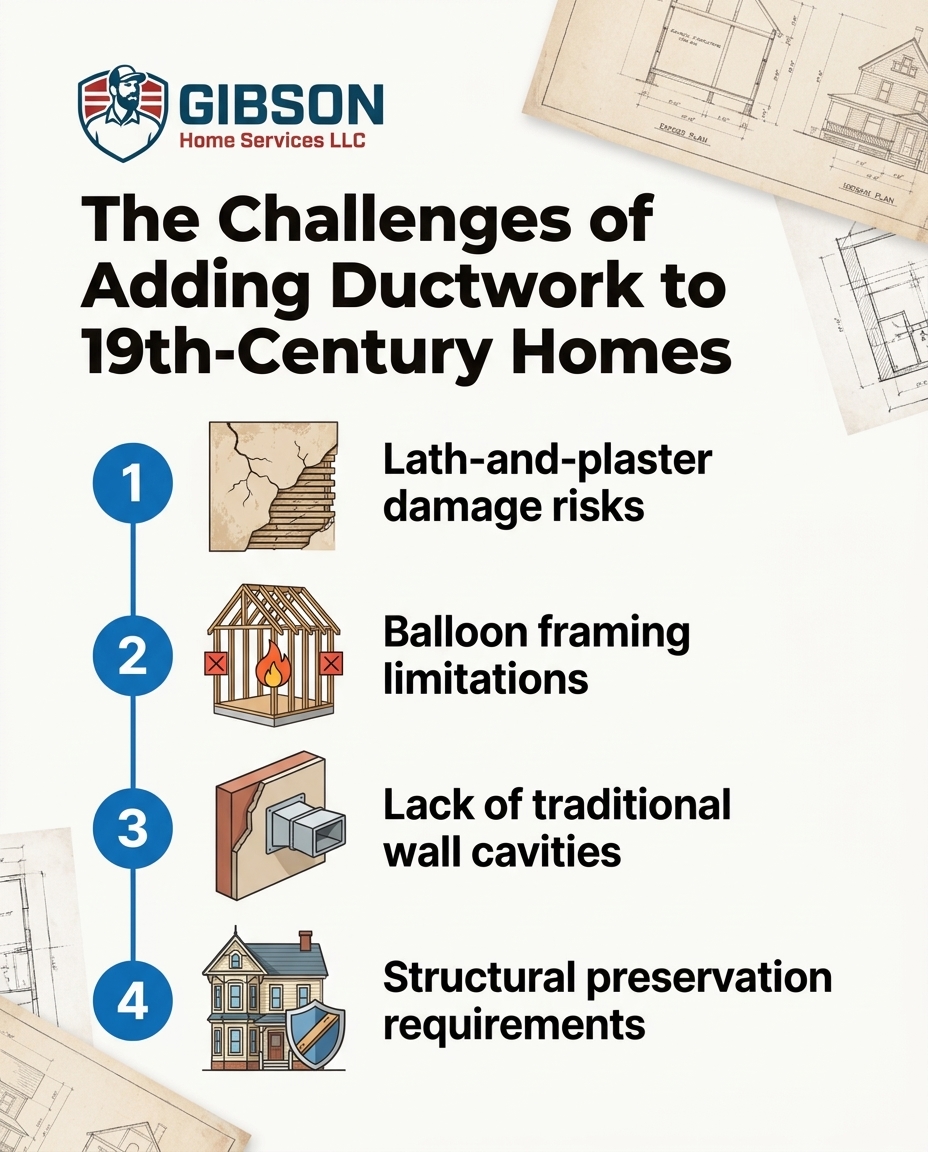
The primary challenges of retrofitting ductwork into historic properties involve navigating structural constraints without causing irreversible damage. The most significant hurdles include:
• The presence of balloon framing, which lacks horizontal pathways for standard metal ducts.
• The fragility of original lath-and-plaster walls, which crack heavily under the vibration of demolition saws.
• The lack of traditional wall cavities, ceiling drops, or built-in utility chases.
• The necessity of preserving original architectural trim, crown molding, and load-bearing old-growth timber.
Can you put central air and heat in an 1800s house?
Yes, you can install central air and heat in an 1800s house, but it usually requires specialized equipment rather than standard sheet metal ducts. Small-duct high-velocity (SDHV) systems use flexible 2-inch tubing that snakes through existing wall voids, allowing for central comfort without destroying your home's historical integrity. These systems are specifically designed to accommodate the tight spaces and unique framing of older properties.
What is the best heating system for a historic home?
The best heating system depends entirely on your home's existing infrastructure and your preservation goals. If you already have radiators, upgrading to a high-efficiency boiler is often the least invasive and most comfortable option. If you lack existing ductwork and want both heating and cooling, ductless mini-split heat pumps or small-duct high-velocity systems are widely considered the superior choices for older properties.
How do you hide HVAC ducts in an old house without ruining the aesthetic?
Hiding HVAC ducts in an old house requires utilizing existing architectural features rather than cutting new pathways. Installers often route flexible high-velocity tubing through backs of closets, alongside chimney chases, or beneath floorboards. The vents themselves are small and can be painted or stained to match original baseboards or ceiling plaster, allowing them to blend seamlessly into the room's historical aesthetic.
Can you safely run ducts through lath and plaster walls?
Running standard rigid metal ducts through original lath and plaster is highly risky and generally discouraged. The vibration from cutting the required large holes usually breaks the plaster "keys" holding the wall together, leading to severe cracking or collapse. If routing through walls is necessary, using the small, flexible tubing of a high-velocity system requires only minor, easily managed circular cuts that minimize structural stress.
Are there generic tax credits available for upgrading heating in older properties?
Yes, there are often federal tax credits and local utility incentive programs designed to encourage energy-efficient upgrades in older, poorly insulated homes. Qualifying high-efficiency heat pumps, ductless systems, and modern condensing boilers frequently meet the criteria for these programs. Because program requirements and availability change frequently, we strongly advise consulting with a tax professional or your local utility provider to determine exactly what incentives your project may qualify for.
Schedule Your Historic Home HVAC Assessment This Fall
Upgrading the comfort of your historic property does not mean you have to sacrifice its architectural heritage. The key is acting proactively during the October pre-winter heating startup window, before emergency breakdowns force rushed, poorly planned decisions. By exploring non-invasive alternatives like high-velocity tubing, ductless heat pumps, or modern hydronic boilers, you can achieve powerful winter warmth while keeping your original plaster and framing completely intact.
If you are tired of battling drafts and uneven temperatures in your 19th-century home, now is the time to consult with a team that respects your property's history as much as you do. Ensure your home is ready for the freezing months ahead by scheduling a comprehensive assessment or Air Conditioning Installation in Medford today. A clear, realistic strategy will give you the modern comfort you deserve, proving that historical preservation and reliable heating can exist in perfect harmony.
Latest articles
Discover more articles

Diagnosing a Low Voltage Short at the Furnace Control Board
When your heating system fails to start this fall, a blown 3-amp fuse is often the culprit. Learn why professionals must trace the entire thermostat wire instead of just swapping the fuse.
Where to Place Carbon Monoxide Detectors Relative to Your Gas Furnace Location
Mounting a safety alarm directly next to your heating system often triggers frustrating false alarms. See why the 15-foot rule provides genuine early warnings without the nuisance.
The Impact of Hard Water on Whole-Home Humidifiers in Burlington County
Mineral scale from local water supplies can quietly choke your heating system's efficiency. Replacing your humidifier water panel before winter hits is critical to preventing sudden comfort loss.